There mustn't be any false tolerance - German politician
Published 26 Oct, 2010 08:10 | Updated 29 Oct, 2010 05:40Society does not have to adopt cultural traditions and the laws of immigrants. There can be no compromise between the German rule of law and Sharia law, which has no place in Germany – a German politician told RT.
The problem with the integration of immigrants into German life is that newcomers want society to adopt their culture – and not vice versa, insists Wolfgang Bosbach, a member of the Christian Democratic Union Party which is part of Germany’s leading coalition.
RT: When the Chancellor said multiculturalism had failed – what did she mean by multiculturalism?
Wolfgang Bosbach: Angela Merkel stated that “multikulti” has failed because in Germany we have too much co-existence rather than togetherness and there are only a few examples of successful integration. There are [actually] millions of examples of successful integration but there are too many examples of refusals and failures. Integration is so important for the improvement of life perspectives of immigrants in Germany. That's why we should not live separately next to each other, so to speak "multikulti", but together.
RT: A lot of the debate has focused on Muslim immigrants rather than the Polish, Italian and Greek population in Germany. Is that fair, to highlight just them as part of the problem?
WB: We've always had immigration in our history. We have immigrants today and will always have them in the future. Three hundred years ago, every third Berliner and Brandenburger was a French protestant. A hundred years ago, Polish immigrants came to work in mining and steel industries in the Ruhr area, but in recent years and decades, people from other cultural backgrounds came, for instance from Turkey, Northern Africa and Arabic countries. And a long time ago we understood that these people have far bigger problems integrating than those who come from our neighboring European countries.
RT: So when we talk about integration – what does your party actually intend to do to help integrate people who are clearly not so at the moment?
WB: First of all it's the task of the people coming here to integrate themselves into society. One can't come to Germany, sit down and say: government, please integrate me. Instead one has to make an effort to become part of this accepting society, and the state has to make offers to make integration work, especially language courses. Hundreds of thousands have visited language courses over recent years. This is a very encouraging result.
RT: There were top politicians addressing this issue of immigration with very strong wording. Do you think that this has tapped into people’s often deep prejudices about immigration and about the Islamic religion that they are actually pretty ignorant about?
WB: I don't think that harsh words were used but rather the right words. Sensible politics begins with looking at the reality. In this reality there are millions of examples of the best kind of integration but there also too many examples of failing and refusing to integrate. And the statistics say that the rate of unemployment among immigrants is double the average among the population. The quota of those receiving welfare among immigrants is three times as high as among the population. And it makes no sense talking around this issue. One must call things as they are, in reality. One cannot say: I find the system of social benefits in Germany very good but not the rule of law. Those who come to Germany must respect the law, the constitution and our cultural traditions.
RT: Could you clarify where the lines are being drawn and what will be accepted in this country and what won’t be? And also your views on the argument that there is now on the back of it the difference between assimilation and integration?
WB: I have no problem with the word "assimilation" whatsoever. It just means "to become similar" or "to become nearly similar". What is the problem with that? Assimilation is ultimately successful integration. It doesn't mean one has to cut their roots or deny their origin. But it means that one feels sheltered by this accepting society. It means it is one's new home country, one is at home here, and not half back in their native country sitting here on packed suitcases. Integration is fulfilled when one says ‘this is my new home country’, and you can also call it assimilation.
RT: The integration and assimilation are two separate things, are they not?
WB: For me assimilation is the ultimate form of integration. Assimilation doesn't mean that I forget what native country I came from, that I deny my origin. If translated word by word, assimilation means, "becoming similar to", and that means integration is fulfilled.
RT: Assimilation is asking people to play down perhaps some of their religious symbols and religious practices to fit in better in the country to which they went, whereas integration for a lot of people means tolerance on both sides, learning how to work together to get the best results. So they are two separate things. What is Germany asking of its immigrants? Is it asking from people not to have mosques, not to wear hijab and obvious religious symbols? Or it is just asking for a greater effort in learning German language and integrate in that way?
WB: I think there is a misunderstanding here. Naturally, there is freedom of religion in Germany but only within the framework of the law and constitution. One goes to church, another to the synagogue, a third to the mosque, and a fourth doesn't attend any house of God at all. What is the problem? But what is taught and what is preached mustn't contradict our law and constitution. That's why we have a special criminal law against so-called hate preachers. Especially at this point there mustn't be any false tolerance. Integration means integrating into accepting society, it means those who have come here must make themselves fit into society. It's not that society has to adopt cultural traditions and the laws of those who are coming. There can be no compromise between the German rule of law and Sharia law. Sharia has no place here in Germany – end of story.
RT: Immigration, especially with Turkish immigrants and the Arabic immigrants, has been happening for decades. Why has the issue become so important now?
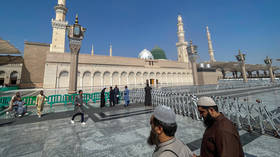
WB: On the one hand it has to do with the big number of immigrants. In Germany we have four million Muslims, not only but mostly of Turkish origin. Their origin and beliefs are becoming more and more visible, for instance through the construction of huge representative mosques, which could as well be seen as a political symbol. There have been heavy clashes lately, in Cologne for example, over the construction of a huge mosque to replace a smaller mosque. It means Islam is getting more visible. On the other hand it has to do with the difference in the progress of integration between Muslims and non-Muslims. It is not necessarily to do with their origin and social state. One example, the children of Vietnamese contract workers in the former GDR, or the children of the so-called boat people, integrate very successfully. The proportion of those children attending the best high schools in Germany is 50 per cent higher than the number of German kids. Consequently it must have something to do with the origin of the parents and their enthusiasm for education. And that's why it's such a big issue now.
RT: Do you also accept that there is also the state's role and the government’s role to be providing the infrastructure to enable the integration to happen – are there any failings of the government as well?
WB: There has been a mistaken perception in German immigration policy that the second and third generations of immigrants would automatically integrate. And why? Because they grow up here, they attend school with our children. And we see more integration problems with the second and third generations now than with the first one. It has taken us a long time to start taking necessary measures, for instance there are nationwide language and integration courses.
When it comes to voluntary attendance of these courses, our expectations are surpassed. That means there is high demand. But when it comes to mandatory attendance of such language courses, due to a lack of language knowledge, the results are rather disappointing, although these people have the highest need to attend. It means there are some more tough years ahead of us.
RT: Your party has been accused by critics of using the issue of immigration to deflect attention away from failings in dealing with other economic and social issues. Is your party playing political games?
WB: This statement is clear nonsense because we like to talk about the economic and social state of the country. And Germany is doing very well. In comparison to other nations our growth rate is above average, we mastered the aftermath of the financial crisis faster and better than others; we have significantly better figures on the job market; as far as I am concerned one could talk all day about the economic and social state of Germany. We talk about immigration and integration because we have very visible problems. Other parties are feeling embarrassed that we are raising this subject. They believe if you make a problem taboo, then you can solve it this way. It reminds me of Donald Duck who used to throw his bills into the fireplace thinking he has no more debts. When politicians hush-up problems they make radical right and left parties stronger. And that's exactly what we want to prevent. We don't want to make problems taboo: we want to solve them.
RT: For decades Germany has had immigrants from Islamic countries and this issue is only now coming to the forefront in such a strong way – why?
WB: It’s because we have been noting for years that we have examples of excellent integration but too many examples of refusals to integrate, and therefore significant problems in connection with that. We experience this with the lack of the knowledge of German in school. If someone doesn't have a good knowledge of German at school they will have difficulty graduating from high school. Without graduating from high school one cannot start vocational training. Without vocational training one has fewer chances on the job market. And we want to break this vicious circle. There is no sensible reason not to talk about it. But the one who is saying there is no problem is only going towards the next point on the agenda. But we don't want to hush-up problems, we want to solve them. And we won't allow anyone to stop us from doing so. People's lives are what matter, as well as how living with each other is perceived and felt about.
There is a big difference between someone who writes a piece for a magazine and owns a penthouse in Berlin and watches the sunset with a glass of sparkling wine, and writes a nice article about multicultural living together, and the last remaining German tenant in a building complex who does not understand the language that is spoken there. And he can't talk with the neighbours any longer, and he feels like a foreigner in his own country. I can just give a piece of advice: take these people's worries seriously.
RT: Would you agree there is a growing nationalist sentiment in the country now?
WB: No.
RT: So, don’t you think there is more to do on both sides on the tolerance issue? There is a number of the population agreeing with very strong statements like Muslims are ‘doing down’ the country, why are there such quotes?
WB: I have to beg you cordially but one should not mix up nationalism and patriotism. A nationalist is somebody who thinks he is better than someone else because he belongs to a certain nation. Patriotism is love for your homeland. Loving your homeland is a good thing. Don't try to make me believe that it's nationalist to stick to your country, defend its laws and values and cultural traditions. It has nothing to do with nationalism. I'm happy for anybody who loves their home country but I want to love my home country as others do theirs, without others saying this is nationalist.
RT: Do you think your political party would be beneficial even if it is promoting extremist views?
WB: I cannot see any extremism at all here.