Kosovo has no place for returning Serbians
Published: 13 November, 2009, 10:58
Edited: 10 January, 2010, 03:39
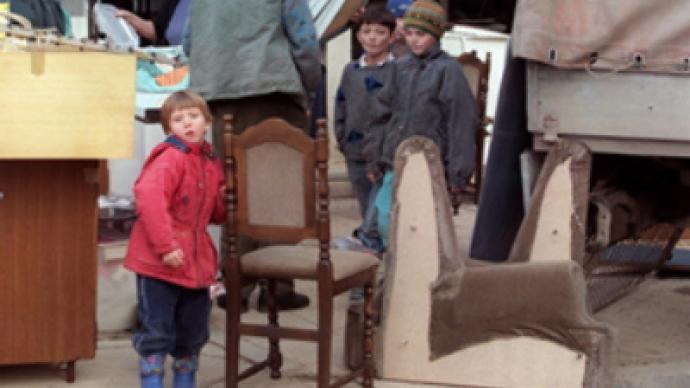
Bosnian Serbians and their families prepare their exodus from a Sarajevo suburb on January 19, 1996 (AFP Photo / Joel Robine)
TAGS: Scandal, Kosovo, Politics, Human rights
Kosovo has come under fire for failing to create conditions for the return of refugees who left the disputed territory ten years ago.
The Organization for Security and Co-operation in Europe (OSCE), which has been closely involved with building institutions in the partially-recognised state, has published a damning report, accusing the Kosovo Albanian authorities of lacking political willpower and refusing to provide sufficient funding.
The armed conflict between Serbia and Kosovo Albanians in 1999 forced tens of thousands to escape the war-torn region. In the aftermath of the conflict, as the ethnic Albanian majority asserted its dominance in the region, many Serbs and other minorities were driven out of their homes and forced into enclaves within Kosovo, or further.
Now, many of the displaced persons are returning. Each year several thousand are forcibly repatriated from neighbouring countries. The report claims the returnees are not provided with housing, and school places, not to mention financial assistance and work opportunities.
“We urge central and local authorities to reach out to these vulnerable groups by allocating necessary funding, increasing coordination and information-sharing, as recommended by the report,” said Werner Almhofer, Head of the OSCE Mission in Kosovo.
The problem is particularly serious for ethnic minorities. Those wishing to return may find that the communities where they belonged to no longer exist. Due to continuing tension with Kosovo Albanians, the remaining Serbian population is now concentrated in a few enclaves. Elsewhere, Serbian–language schools have shut down, and even access to basic medical care is patchy.
“It is not surprising that the Albanian authorities are not helping Serbs return, but the Serbs are also not in a rush to abandon their homeland and live in the unfriendly environs of Kosovo,” says Lev Voronkov of Moscow’s State Institute of International Relations, adding, “This report is no surprise, and I do not expect there to be any changes to the situation for a long time.”
The OSCE calls for greater financing, and more officials to be specially trained to deal with returnees. So far, the government in Pristina has not responded to the report.
Igor Ogorodnev, RT

“Fall of Berlin Wall symbolized the collapse of Iron Curtain”“The fall of the Berlin Wall has generally been recognized as a symbol of the downfall of the Iron Curtain, an end to the ideological confrontation,” said Russian Foreign Ministry Special Envoy Andrey Nesterenko. |
13.11.2009, 14:36
1 comment
ROAR: “President’s surprise for non-profit organizations”New approaches of the state in different spheres should help the chief task of modernizing the country, analysts say, commenting on the president’s address to the parliament. |
The Albanians have been given every opportunity to bring justice to Kosovo, instead the Albanians have turned Kosovo into one of the most corrupted cesspools of crime in Europe. Albanian organized crime pushing drugs, human slaves and Islamic extremism now uses Kosovo as the home of their operations to escape scrutiny in Albania proper. Like in Afganistan & Iraq, NATO gives these criminals free hand in exchange for political authority. If the world press turned this Kosovo rock over they would be shocked at the depth of depravity they'd find.
I would not let the Serbs back into my country either. They are parasites who only care about their genocidal ways and claiming new territories and they are losing all of their territories every year. Maybe one day they wont exist and this world will be a much greater place.


Tito , who was a Croat operating out of Belgrade, was able to unify Yugoslavia and to build what was then a happy country (with the exception of the Albanians who were trying to grab part of Serbia). As an impartial visitor who travelled from North to South , I found Yugoslavia was a happy country with no problems between Croats and Serbs when I had a nonth long holdiay by car there in 1970. I was then truly amazed and disappointed when the trecent roubles started there because it was started and encouraged by parties from outside Yugoslavia. Once Tito 's rule ended, all those from outside Yugoslavia started to meddle , with disastrous results which have led to ethnic hostilities which will last hundreds of years, in what had been a happy country only 20 years earlier. So much for "freedom" and "human rights" enforced with the barrel of a gun. Why was it not left alone as it was doing alright the way it was and people were reasonably happy- but now they are only pins on maps in Western Europe and the USA.