Scandalous opposition leader creates new political party
Published 10 Jul, 2010 11:38 | Updated 12 Jul, 2010 12:20
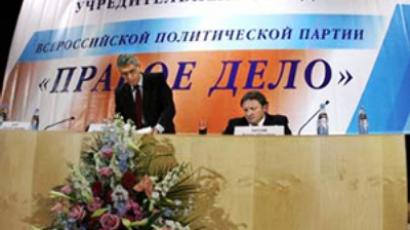
Russian writer and controversial opposition leader Eduard Limonov has set up a new political party, RIA Novosti news agency reports. For the most part the party comprises of representatives of nonconformist youths.
The Other Russia party, which intends to participate in Russia’s 2011 parliamentary elections, is yet to be registered with the Ministry of Justice. In case the party is denied registration, it will defend its rights in court, Limonov said while addressing Other Russia’s founding congress.
The 150 delegates from 50 regions of the country who were present at the gathering unanimously voted for the creation of the new party and all became its members.
However, under Article 3 of the Federal Law “On Political Parties”, to be officially registered a party should have at least 45,000 members. In addition, in more than half of Russia’s 83 constituent units, it should have regional offices with at least 450 members.
The congress voted for the party’s program, one of whose main goals is “decisive democratization of the country.” It also includes the principle of regular turnover of power, nationalization of energy sector, and the cancellation of the obligatory army draft.
The program also stipulates moving Russia’s capital from Moscow to South Siberia, where a new city is to be built from scratch for this purpose.
Limonov, who was the only speaker at the congress, pointed out that the new party combines both left and right principles, and branded it as “centrist.”
Previously, the politician headed so called National-Bolsheviks party, which was closed down by authorities in 2007 after being deemed an extremist organization.
The leader of the Solidarity opposition movement, former Prime Minister Boris Nemtsov, said the Other Russia is “Limonov’s personal project, which has neither firm ideological nor personnel grounds.”
Previously an opposition coalition was united under the name Limonov picked for his new party.
“If the new party base is the coalition ‘The Other Russia’, it is too ill-sorted,” Nemtsov told Interfax agency. The coalition gathered “completely different people with diametrically opposite political views.”
“It united national-Bolsheviks, nationalists, liberals, social-democrats, and socialists,” Nemtsov said, adding that there are no parties similar to that one anywhere in the world. “A party should gather people who are at least ideologically not too far from each other. “What do liberals, nationalists and socialists have in common? Nothing, I believe,” he is quoted as saying.