Reset: Will West heed Moscow's wake-up call?
Published 24 Nov, 2011 12:46 | Updated 24 Nov, 2011 17:30
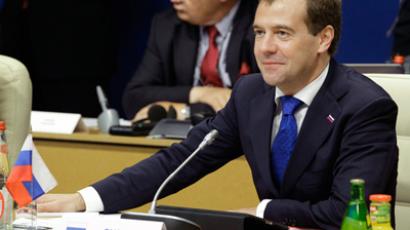
President Dmitry Medvedev on Wednesday sent a wake-up call to Western leaders, telling them in no uncertain terms that Moscow will deploy long-range ballistic missiles on the European border as countermeasures against the US missile defense system.
The Russian leader’s announcement sent shock waves through European capitals, although earlier this year Medvedev had warned that “another arms race” was in the offing unless Moscow was included in the European missile defense project. Since then, however, negotiations between Russia and the West on how to resolve the missile defense standoff have only produced empty words. Moscow wants guarantees that the system will not threaten its security – the US has not provided these.Following Medvedev’s announcement, NATO Secretary General Anders Fogh Rasmussen was one of the first to respond.Via Twitter, Rasmussen mused: "The suggestion that deployment of missiles in the areas neighboring the alliance is an appropriate response … is very disappointing. NATO's missile defense system [is] designed to defend against threats from outside Europe. Not designed to alter balance of deterrence."Despite, or because of, such assurances, Russian observers say it is naïve to believe that such a sophisticated system will not in itself upset the “balance of deterrence.” Imagine the American response, for example, should Russia decide to build such a system on South American territory. More tellingly, perhaps, the 28-member military bloc refuses to anchor its heavy verbal promises with any sort of legal guarantee (i.e. contract). Naturally, this refusal to undertake what amounts to a trip to the local notary only intensifies Russia’s suspicions about the nature of the missile defense project."The path towards [an acceptable agreement on missile defense] demands the creation of a clear legal basis for our cooperation that will reflect our legitimate interests," the Russian president said.After all, Moscow was burnt once by taking the western military bloc at its word. Following the collapse of the Soviet Union, NATO officials promised not to expand further in Russia’s direction. The pledge, however, carried no written guarantees, and NATO conveniently forgot its promise at the earliest opportunity. Understandably, therefore, Russia is drawing the line on NATO expansion at European missile defense. Although it may not be able to halt the system, it can take preventive measures to ensure that its managers – who may change allegiance according to the unpredictable US political winds – do not wake up one morning with the notion that Russia is the enemy.Whatever the case may be, Washington remains adamant – despite Moscow’s warning that it will be forced to take counter-measures that could escalate into another arms race – that it will not change its plans for the European missile defense system.US National Security Council spokesman Tommy Vietor says the US wants cooperation with Russia, but will not “limit or change the program.” He said the system is designed to enhance the security of US allies in Europe, as well as that of Russia.Washington’s intransigence over missile defense is not only working to offset the reset. Also hanging in the balance is the New START, a landmark treaty signed between Presidents Medvedev and Barack Obama last year in Prague. The breakthrough document, which now appears to be heading into the trash bin, set the number of ballistic missiles permitted to the former Cold War enemies at 1,550 apiece.
Is the ‘reset’ doomed?
German analyst Alexander Rahr believes that Medvedev’s tough response to the US and NATO refusal to cooperate with Russia is in part “a manifestation of his disappointment with the reset in relations with the United States.”"It is the reaction of Medvedev himself as the outgoing president to the reset policy,” Rahr told Interfax. “It is his disappointment and the realization that the dialogue on missile defense is not developing.”The analyst noted that reaching understanding on missile defense had been a key component of the reset process, but Washington apparently had other plans."The Americans want to build the missile defense system despite the general improvement in the atmosphere of relations," Rahr said.In the analyst’s opinion, Medvedev’s order to activate the radar warning system in Kaliningrad instead of deploying Russia's own missile defense system is actually a “restrained reaction."It should be noted, however, that Medvedev certainly foresees boosting Russia’s strike capabilities in light of the disappointing breakdown in missile defense talks."Strategic ballistic missiles, which enter service in our Strategic Missile Troops and our Navy, will be fitted with advanced anti-missile and new highly-efficient warheads," the Russian leader said.Russia’s Armed Forces have been tasked with developing measures "ensuring, where necessary, the destruction of the information and control capabilities of a missile-defense system," Medvedev said."If the listed measures are not enough, Russia will deploy in its west and south modern strike weaponry systems ensuring the defeat of the European component of the missile-defense system. One of these steps will be the deployment of the Iskander missile system in the Kaliningrad region”, the Russian president added.
America to blame?
Dmitry Rogozin, Russian Ambassador to NATO, said that the United States was "obviously" behind the rejection by all NATO members of a Moscow proposal for a joint missile defense system for Europe."The plan was turned down, first by the Americans. Then, the NATO countries were reading out carbon copies of this refusal to us – refusals obviously written not in their own capitals, but in Washington," Rogozin told a news conference in Moscow.The NATO envoy explained that the plan proposed by Moscow during the NATO-Russia summit in Lisbon last year would have involved the alliance and Russia building joint missile defense."The idea was to combine the information systems of missile defense, that is satellite groups, ground radars and sensors in order to jointly monitor sources of missile threats, exchange information and evolve plans to counter risks of southern provenance," he said. At the same time, interceptor missiles would have remained under national control, he added.
Door still open
According Mikhail Margelov, head of the Russian Federation Council's International Affairs Committee, Medvedev’s stern warning on missile defense does not mean the end of the Russia-US reset."Disagreement on the [missile defense] problem does not mean 'an end to resetting'," the senator told Itar-Tass. "Disagreement on just one of the many items on the agenda of Russian-American relations is no reason for rupture.”Margelov mentioned other areas of critical cooperation between Russia and the US, which could work to prevent deterioration in bilateral ties."If agreement was not reached today, this does not mean that it cannot be reached tomorrow, especially as Russia has several joint projects in the security area with the United States and NATO – the transit of cargo of the alliance over Russian territory to Afghanistan, the fight against the flow of Afghan drugs, against piracy off Africa's coast, joint space projects and many other things," Margelov said.He backed up his confidence in the possibility of continuing the Russian-American dialogue by noting that occasional problems between allies are normal."Discrepancies in the security area… happened even between the closest allies in the past." He offered as an example the French withdrawal from NATO during the government of Charles de Gaulle, as well as Romania’s refusal to participate alongside troops of the Warsaw Treaty Organization."The Russian president gave today a clear signal that a strong Russia is not a menacing Russia,” he said. “A strong Russia is a country that does not forego its national interests.”
Russia’s international obligations safe
Konstantin Kosachev, chairman of Russia’s State Duma foreign affairs committee, said Medvedev’s plans do not run counter to Moscow's international obligations, including on the New START treaty."Looking at it from the angle of obligations, the Russian President's statement doesn't add or take away anything from them," Kosachev said. "The President quoted the provisions the START treaty contains, and they envision an opportunity for Russia to sever the agreement if the strategic balance is disturbed."The MP believes that this is precisely the situation where the strategic balance may be frustrated if the US creates a strategic missile defense system."This isn't a reality yet from the angle of practical steps but, sadly enough, the plans made public by the United States do presuppose this," Kosachev said.The MP said that Medvedev's statement was absolutely timely, and unavoidable in light of the situation."Relations between the two countries don't presuppose any unilateral actions on the part of the US in what concerns the creation of strategic antimissile defense that could break up the strategic balance," Kosachev stressed. "This would be unacceptable for Russia, and that's something Medvedev spoke about."“It's up to the United States to decide whether to build relations with us as a friend or an enemy, but we have a response to any version the Americans opt for," he said.Robert Bridge, RT