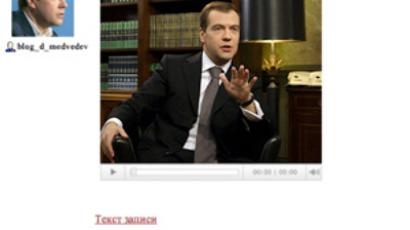
Medvedev urges continuing war against corruption
Published 20 May, 2009 20:09 | Updated 21 May, 2009 00:09President Dmitry Medvedev has entirely dedicated his latest video blog to the fight against corruption in Russia.
He presents the facts, what’s already been done on this most crucial issue and what still needs to be done about this most-significant problem facing every state.
____________________________________________________
This time I would like to talk about a very difficult topic, one which is unfortunately extremely important for our country. I am talking about the fight against corruption.
It is a known fact that corruption is one of the main obstacles to economic growth and development. Of course, this is an international problem as well, a problem for each separate country. Because there are no states without this problem. But let's ask one simple question, what state has the lowest level of corruption?
First of all, on the one hand, it is developed democratic states that have a free modern economy, high living standards, and what's equally important – a highly developed legal awareness. Or, on the other hand – totalitarian states that have none of the things I just listed. In transitional societies, however, corruption is often off the charts.
Unfortunately, we are at this transitional phase at the moment. I don't think I need to explain why. Besides, history of the state, traditions, national characteristics and many other things also play a big part in the level of corruption. In this sense, corruption in Russia unfortunately has long centuries of tradition. And today it penetrates all areas of our life. There is corruption at all levels of power. But there is corruption at the common level as well. And we don't know which kind of corruption is more dangerous for the country, which one is worse. It is two sides of the same coin.
Transparency International published some data last year. On the corruption rating list our country is unfortunately number 147 out of 180. There is another number that surprises at first, but in reality it should really bother our country. According to some polls, a quarter of our citizens don't see corruption as anything abnormal. They welcome corruption. So in society as a whole there is no intolerance of corruption as an institution.
A year ago one of my first decrees was to form the President's Anti-Corruption Council. We decided and I stated it openly that we should have a systematic reaction to corruption as a systematic thing. And we began to move on this difficult and long journey. What has been done in one year?
First of all, the national anti-corruption plan has been developed and accepted. It came into effect, it is working. Secondly, a package of anti-corruption laws has been developed and accepted. I signed a number of decrees that give more control over the actions of state and municipal officials, and heads of state corporations. Now not just state officials themselves declare income, but also their family members. Now we have the legislative basis for that. And the President is not an exception to this rule. This information will be posted on official web-sites and made available to the media. And I want to say that there is not going to be less information than this year.
We also need to develop mechanisms for verifying the data provided by officials. In essence, for the first time in modern history, we need a legislative framework for this. I have been told several times – the fight against corruption is not going well, because we don't have this term, our legislation doesn't work. Now we have everything. We have the term, it has been defined. We have legislation, but it is extremely important that lawmakers understand how this law should be applied. Law enforcers should in turn also understand how to apply this law. All state officials need to understand their responsibility. This legislation is not simple. We don't have any experience in applying it yet. There are many sensitive issues; we will have to make sure these laws are applied carefully.
And perhaps the hardest thing. We must create the motivation for rightful, legally appropriate behaviour – with the help of legislative instruments, through the media, using civic society. And corruption should not be simply illegal, but indecent. This could be the most difficult part.
The participation of the civic society is certainly an indispensable condition of success in this struggle. Such work can’t be one-sided. Let me quote an idea voiced at a session of the Presidential Council recently – on promoting the Development of the Bodies of the Civic Society and Human Rights – that where there is corruption, there is always human rights violation.
In this respect, the struggle with corruption is, first and foremost, civic control, and I fully back the idea of its development, in all kinds of forms. If we take blogs, for instance, it proves a rather good and, so far, generally independent indicator.
I was pleased with one more thing. On my video blog page, 45 various subjects are listed. Some topics provoke the majority of responses, among them, the financial crisis is, for understandable reasons, the top. Counteracting corruption is the fourth, which means it is of concern to people. Authors in LiveJournal are not indifferent to it either. I do read your comments and I'm aware there is a common wish to fight corruption, at least by those people who write about these things.
As our citizens start analysing rather serious subjects like the information on state purchases of goods and property, it’s a good sign. This information is published on the website for this particular purpose. It is because for us it is important to know how our money is spent, the money of all the taxpayers.
Concerning state purchases. We have more than once discussed a transition to electronic trading. The necessary normative acts have been adopted, but so far nobody hurries to do anything. We have to pay utmost attention to creating such electronic instruments which undoubtedly are progressive.
Much has to fall into place, of course, as society develops. This concerns the importance of having proper living standards, an awareness from everyone that it's better and, which is no less important, to live according to the laws. It’s a very important incentive.
There must be other incentives, too, including material ones. We must select people for public service who are simply good and decent, who apply for higher education institutions not with the aim of taking bribes later on, but who are motivated to serve the state. It is only this way that it will be possible to create an anti-corruption standard of behaviour in our society.
On 7th May our country signed an additional protocol of the EC Civil Law Convention on Corruption, which is a really important and serious decision, meaning we are advancing our regulatory system, which is modern and not Russia-based, but also integrated into the world regulatory system aimed at fighting corruption.
It’s also true that among the causes of high corruption in our country there are imperfect political institutions and a lack of professionalism from our bureaucrats on the one hand, and our citizens’ failure to understand and know, especially a wish to know, the laws.
In this respect, the state and the civic society must work with all kinds of social groups. I am sure it is possible to inoculate the culture of law if only from a very early age, by studying the laws and the practice of law from early school years. It’s up to the teachers, of course, to ponder how to make it work, but we need to pass these decisions anyway.
Incidentally, a new section was opened on my website – about judicial power, and I hope our children, modern children will be growing with the awareness the court is without doubt the summit of justice, a body of power with an unquestionable authority, to be turned to when it comes to protecting one’s rights, liberties and interests protected by the law, as legal experts usually say.
Essentially, the court of justice is the main, or supreme, anti-corruption body. It's word will always be the last and destined to create the truth eventually.
I have been long thinking whether it was expedient to open this new stage in the fight against corruption. I think it was the right move. And we have to move forward in this direction, even in small steps. Therefore we will have to come back to this subject over and over again.