State role in orchestrating modernization
Published 9 Sep, 2010 14:43 | Updated 13 Sep, 2010 15:16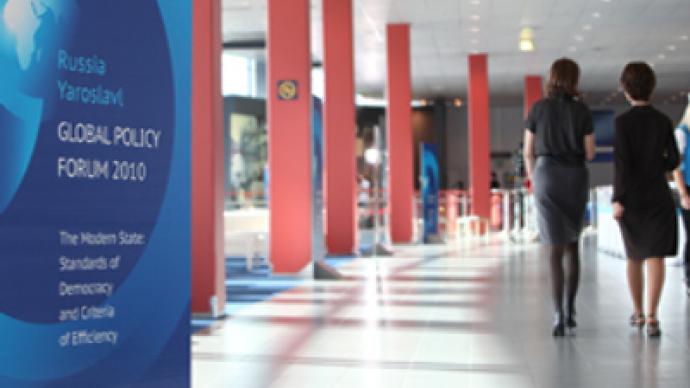
What role should the state play in modernizing the economy and what steps should Russia take to move forward on the path to innovative economy? Participants at the Yaroslavl forum have been sharing ideas on this matter.
Politicians, businessmen, scientists and experts from about 35 countries have descended on the Russian city of Yaroslavl to join a global policy forum entitled “The Modern State: Standards of Democracy and Criteria of Efficiency”. One of the topics in focus is “The State as an Instrument of Technological Modernization”.
The Russian economy has long depended on exports of energy and raw materials which is in fact a way to nowhere. Having announced a new course – for the modernization – the country is now seeking to diversify its economy.
Keeping pace with the modern world rather than lagging behind new technology is a challenge that every state faces today. But for Russia “it is a matter of survival”, according to Deputy Prime Minister Sergey Sobyanin.
“Russia is a large country with a huge territory, vast resources and relatively small population,” he said addressing the forum participants. That is why competitiveness to the country, he explained, is not an abstract notion, but is a concrete matter its survival. Russia simply cannot afford to be weak, it can only be strong, he stressed.
Modernizing the economy is crucial for Russia and that is something everyone agrees on. The role of the state in this process is also unquestionable. But how to move from slogans to reality, what steps should be taken and to what extent the state can interfere is not yet certain.
One of the goals of the Yaroslavl forum is to find answers to those questions by sharing experience with countries that have already managed to achieve results on the path of the modernization. Representatives of the US, China, Israel, Brazil, Japan and Singapore arrived at the forum to present their views on the matter and, also, give their advice.
There is no general recipe that would suit anyone and Russia – by looking at the experiences of other nations – should choose its own way to create an innovative economy. However, there are several ingredients that cannot be ignored.
The most crucial one is the state support primarily to small and medium businesses, as well as science and education. However, just pouring money into those sectors does not automatically lead to their development. The state should wisely and – what is even more important – efficiently orchestrate the process.
As the head of Russian Railways, Vladimir Yakunin, stressed, before investing money and giving financial support, the state should define what would it want the money to be spent on. Scientific research, he underlined, should be “commercialized”.
And yet, that is just one of the steps the state should take. Erik Reinert, the author of the report “Modernization in Russia: the third round”, pointed that only if authorities at all levels – from federal to local – lead the same policies the efforts can yield results.
Anatoly Chubais, the head of Russia’s Nanotech Corporation, said that "economic modernization can create demand for political modernization,” and the latter in turn – demand for democracy, “which is now in short supply." Economic modernization, he stressed, cannot be holistic and complete without political changes.
Speaking about the role of the state in the modernization, he said that there are two opposing opinions on the matter. While some people believe that it is only the state that can actually push the process, since business interests are momentary, others are confident that bureaucrats can only ruin the process. Rosnano, he said, does not share either of these views.
“This approach is not constructive. We should find a reasonable balance,” he stated. As an example of such a balance, he mentioned Israel, where the state is rather active, though neutral.
Israeli representative Yigal Erlich, head of venture company Yozma, spoke about his country’s experience in creating an innovative economy. In addition to the role of state, he mentioned a component that is also of crucial importance – human capital. Speaking of that, Erlich noted that about a million immigrants from Russia – most of whom were highly educated people – have contributed a great to Israeli human capital, which was a great “gift”. He assured that Israel will pay Russia back for that gift and vowed that his country is ready to co-operate with Russian partners.
Natalia Makarova, RT