VERSIONS: روسيا اليوم NOTICIAS FREEVIDEO ИНОТВ RTД
breakingnews
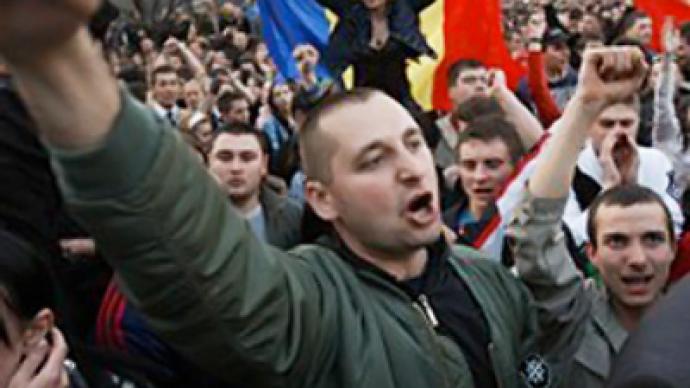
Go to main page   Politics   Moldova dubs June 28 “Day of Soviet Occupation”  
MORE ON THE STORY
18.02.2010, 19:13 5 comments

Romania’s decision to host US missiles sparks regional domino effect

Romania and Moldova have kicked off bilateral talks as unrecognized republic Transdniester says it's ready to host Russian missiles on its soil. Meanwhile, Bulgaria is considering its participation in US missile defense.

23.02.2010, 21:42 7 comments

Moldova welcomes US ballistic missile defense system to Romania

Moldova is downplaying Romania's decision to host elements of a US missile defense system on its territory.

30.11.2009, 18:41 32 comments

New Polish law equates Communist and Nazi symbols

Europe has long been condemning the communist regime, but none of the countries has gone as far as Poland, where a law was signed allowing people to be fined or imprisoned for keeping and buying communist symbols.

Russian Prime Minister Vladimir Putin (R) and Polish Prime Minister Donald Tusk (L) attending a memorial service, (RIA Novosti) 07.04.2010, 18:39 24 comments

Blame for massacre of Poles cannot be put on Russians – Putin

The crimes of Stalin’s regime cannot be justified, Premier Vladimir Putin has said. He added, however, that Russians cannot be blamed for the 1940 massacre in the Katyn forest, where over 20,000 Poles were executed.

Netherlands, The Hague: Radovan Karadzic (AFP Photo / Valerie Kuypers) 04.11.2009, 00:52 1 comment

Karadzic makes his first court appearance

Former Bosnian Serb president Radovan Karadzic has appeared in the International Criminal Tribunal for the former Yugoslavia (ICTY), in The Hague for his trial.

Albanian militant commander "Snake", now Kosovo's Prime Minister Hashim Thaçi (in the center), back in 1999 (from www.ladepeche.fr 04.06.2009, 11:25 5 comments

Purely Islamic state set up in Europe

In Kosovo, a Muslim state has been allowed to spring up in the heart of Europe, says Milorad Dodik, the Prime Minister of Republika Srpska, one of the two parts of Bosnia and Herzegovina.

Citizens of the northern Bosnian town of Banja Luka display a portrait of Bopsnian Serb war crimes suspect fugitive Radovan Karadzic as they celebrate Serbia-Montenegro's 9-8 victory against Croatia in the final of the European Waterpolo Championship in the Slovenian town of Kranj 15 June 2003 (AFP Photo) 01.03.2010, 09:27 3 comments

Villain or hero? Karadzic trial resumes in The Hague

Radovan Karadzic, the wartime leader of the Bosnian Serbs, has accused prosecutors in The Hague of fabricating the evidence used during his tribunal. The comments were made as his trial resumed on Monday.

01.09.2009, 18:47

Turkey and Armenia to reset diplomatic ties

Turkey and Armenia have agreed to establish diplomatic relations in order to reopen border crossings that have been closed since 1993.

01.09.2009, 12:55 31 comments

Heated debates as WWII commemorated

Leaders from around the world are in Poland to mark the 70th anniversary of the outbreak of World War Two. The country was the first to face the Nazis’ attack on September 1, 1939.

Soviet soldiers in the Battle of Stalingrad 01.09.2009, 20:58 6 comments

“Overwhelming guilt goes to Germany” for starting WWII

“There’s possibly some guilt [for the invasion of Poland] on the Russian side and on the British and French side, but in general it’s definitely Germany,” Reinhard Krumm, an expert on Eastern European history, told RT.

Moldova dubs June 28 “Day of Soviet Occupation”

Published: 24 June, 2010, 20:24
Edited: 17 August, 2010, 19:14

TAGS: Breakaway regions, Conflict, Military, Russia, Politics, Europe, History


Moldova has declared June 28 the “Day of Soviet Occupation.” The country’s interim president, Mihai Ghimpu, signed the relevant decree on Thursday.

Talking to journalists, he said that memorial events will be held in the capital Chisinau and throughout the country on June 28, “the day of the 70th anniversary of the Soviet invasion of Moldova.” All entertainment activities will be cancelled and at 10 am the entire republic will plunge into silence for a minute, mourning the victims of the Communist regime.

In addition, a memorial stone will be erected on National Assembly Square, in front of the parliament building, where a Lenin monument used to stand.

“Later on, this will be the place of a monument to victims of the Communist regime,” Ghimpu, the republic’s acting president, was quoted as stating by the Interfax news agency. “June 28, 1940, was the beginning of our people’s tragedy – deportation, deliberate famine and de-nationalization. We must remember this."

He added that he signed the decree having closely studied the findings presented by a commission he directed last year to evaluate the “totalitarian Communist regime in Moldova.” He also considered the conclusions drawn by the Moldovan parliamentary commission on assessing the non-aggression treaty between Germany and the Soviet Union, also known as the Molotov–Ribbentrop Pact.

"There is no doubt that June 28, 1940, when Soviet forces entered Bessarabia, was a really black day in the history of Moldova,” Ghimpu said. “So, we will observe it as a miserable day of the beginning of Soviet occupation.”

On June 28, the commission will present its findings at a special parliamentary session.

The Moldovan leadership is also planning on banning Communist symbols and the Communist Party, which ruled the republic until recently and is currently an opposition party, Itar-Tass reports.

The Moldovan leader noted that prior to making the decision to sign the decree he didn’t hold any consultations with his colleagues from the ruling West-leaning coalition Alliance for European Integration. The faction members’ reaction has yet to be heard.

The move is sacrilege – Moscow

The Russian Foreign Ministry has deemed Ghimpu’s move to name June 28 the Day of Soviet Occupation “sacrilegious”.

It is “an element of a planned political campaign” aimed against the Russian-Moldovan partnership, the ministry said in a statement published Friday on its website.

According to the ministry, it is not the first time “pseudo-historic interpretations of causes and results of the Second World War– decorated as memorial dates – [have been] used as abasement for timeserving decisions made only in the interests of the ruling top and against national interests of the state.”

This yet another “attempt to rewrite our common history with the Moldovan people, and events connected to the Great Patriotic War of 1941-1945.” It is “sacrilege”.

Moscow says the motives behind the move are clear. It is aimed at “escalating emotions, distraction of public attention from the real problems of today’s Moldova and concurrently to break existing stability mechanisms on the Dniester River”.

The Foreign Ministry expressed hope that pragmatic approaches will prevail within Moldova’s ruling coalition and “the country will pursue policy aimed not at splitting, but at consolidating Moldovan society and at real and constructive development of Russian-Moldovan relations.”

Chisinau demands Russian troops’ withdrawal

Ghimpu’s decree also demands that Russia, as the successor to the Soviet Union, should immediately withdraw its troops from Moldova, where they are currently stationed on a peacekeeping mission.

Russia’s peacekeeping contingent – the Operative Group of Russian Troops (OGRV), previously known as the 14th Army – is stationed in Transnistria, the republic’s breakaway region. In addition to the peacekeeping mission, the roughly 1,500-men-strong OGRV also guards stores with weaponry which belonged to the Soviet Union and now is Russia’s property. Part of it has already been transported to Russia.

Shortly before the collapse of the Soviet Union, on September 2, 1990, five regions located mostly in a strip between the Dniester River and the eastern Moldovan border with Ukraine – concerned over statements by some radical groups in Chisinau calling for uniting Moldova with Romania – declared the creation of the Transnistrian Republic. The Moldovan leadership did not approve of the move and sent troops into the region, which resulted in a military conflict in March 1992 that lasted until July.

Currently the peace in the conflict region is maintained by Russian, Moldovan and Transnistrian peacekeeping contingents and by Ukrainian monitors.

Talks on settling the Transnistrian conflict should be resumed – Russian FM

Russian Foreign Minister Sergey Lavrov has said that Russia, Germany, France and Poland have called for resuming talks on settling the Transnistrian conflict, which were suspended in February 2006. The so-called “5+2” talks included Moldova and Transnistria as the main parties, Russia, Ukraine and the OSCE as mediators and the E.U. and the US as monitors.

However, Lavrov underlined that for the parties to return to negotiating table, the Transnistrian leadership need to have a clear idea of who exactly speaks for Chisinau, Itar-Tass reports. Meanwhile, contradicting statements coming from Moldova do not add to Tiraspol’s wish to go back to talks, Lavrov said.

The top Russian diplomat was discussing European security issues with his counterparts from Germany, France and Poland in the framework of the so-called “Weimar Triangle.” Summing up the results of the talks, Lavrov said Russia and the EU have agreed to join efforts to convince Chisinau and Tiraspol to resume talks.

“The main task is finding a mutually acceptable solution to the conflict within the framework of maintaining and strengthening Moldova’s sovereignty,” he said.

Natalia Makarova, RT

+9 (19 votes)
 
Back to top
next MORE NEWS
24.06.2010, 17:37

ROAR: Russia joins Weimar Triangle to discuss European issues

Russian Foreign Minister Sergey Lavrov for the first time discussed European security with his counterparts from Germany, France and Poland in the framework of the Weimar Triangle.

US President Barack Obama(L) and Russian President Dmitry Medvedev make their way from the stage following a joint press conference June 24, 2010 in the East Room of the White House in Washington, DC (AFP Photo / Mandel Ngan) 24.06.2010, 23:02 1 comment

Russia-US relations are not all about security – presidents

Russia and the US have some disagreements, but neither side will let that get in the way of a strong working relationship – that was the message from Dmitry Medvedev and Barack Obama, who held a joint press conference.

Medvedev-Obama
Alex July 05, 2010, 16:07
+1

......continued As a reward for Moldavia and Wallachia's help against the Turks Russia decided to tear off the northern piece of Old Moldavia (called Besserabia) and incorporate it into its territory. Whereas Romanians had initially heralded the Russians and heroes and liberators who had fought alongside them as "Orthodox Brothers", Russian subsequent annexation sparked outrage and resentment. The fact that Besserabia was then subject to an aggressive policy of Russification up until 1917 did not help matters and the Besserabians themselves rebelled and protested the fact that their culture and way of life was being wiped out as the Kermiln was attempting to estalish "Novorossija" on their territory. During the 1800s, whilst Russia occupied Besserabia, the southern half of the Old Moldavia united with Wallichia and together they formed the first Modern Romanian State. At the end of World War 1 Transylvania (up until then under Hapsburg rule) and Besserabia joined the union and Greater Romanian was formed. The union with Besserabia took place under lawful and democratic means with the territory's elected legislature (Sfatul Tarii) voting overwhalmingly in favour of the political union. The notion that Romanian and Moldovan are separate languages is actually a concept that was conjured up by the early Soviet Union in its attempts to re-annex the territory. The reasoning went that it was necessary to created the impression of division between Besserabia and the rest of Romania in order to justify Soviet claims over it and for the next two decades the Soviet Union put a considerable amount of effort into creating a new language and new history for the "Moldovans". Needless to say, Soviet claims have bee repeatedly discredited by the simple reality that despite intense political and social pressure, the Kremlin was never able to get the Besserabians speak what it deemed to be "Moldovan". Today, as always, Besserabia remains fundamentally Romanian

Alex July 05, 2010, 15:37
+1

Facts: Romanian and Moldavan are the same language. There is no point in trying to debate this because it is an observable fact. I am not ethnically Romanian, I learnt Romanian as an adult and despite this I can easily understand the language spoken by people in Chisinau. In fact, I would submit that the two dialects are closer to one another than one might observe between American and British English. Whilst it is true that Romanian went through a process of "re-Latinization" in the 1800s, it is extremely ignorant and foolish to state that the language resembled Russian prior to this. Certain Slavic worlds that had previously been adopted fell into disuse, but the change was largely superficial. In fact, Romanian is one of the best preserved languages in Europe today. Any contemporary Romanian can read texts that are hundreds of years old without much trouble. I recently read Neacsu's Letter (the oldest surviving Romanian text) and I could understand it perfectly. The illusion of "Slavonic Romanian" stems from the fact that the language was originally written in cyrillic script and also due to the fact that old church Slavonic became an important language due the the spread of orthodoxy throughout the country. The Old Moldavian Kingdom encompassed Romanian Moldavia and today's Republic of Moldova as well as some territories that currently form part of the Ukraine. The Moldavian Kingdom and Wallachia eventually fell to the Ottoman Empire and were subject to its rule for approximately 400 years, under a state of suzerainty. In the early 1800s Imperial Russia came into conflict with the Turks over South Eastern Europe. It was an imperial turf war which was won by Russia. The Romanian principalities fought alongside Russia as allies and made an important contribution in helping the Russian Empire.

Xenon June 30, 2010, 20:51
+1

Dear Vova KGB did a good job with you. Your logic is like this: in the XIXth century ALL the Romanians stopped speaking a Russian language and learn all of them a new Romanian language with more Latin and French words. What will happen next? All the Romanians will learn Chinese and will become part of the Han family? KGB agrees with this theory? Tell them , maybe you'll get a promotion. This aberration can be accepted only by some propagandist apparatchiks. How do you visualize the process? Exams to test the new knowledge?:) The shepherds failed at first at the exams and pass after? It was a reform like in all the languages but not as you call it. You cannot resist as an empire with this type of logic, my friend. Soon the nations that are occupied by your people will be liberated: Caucasus, Siberia, you'll see. What YOUR history say about them?? They were Russians and after a while they learn another language because USA paid them? Violence does not always is victorious especially when the intelligence behind it is of this kind. I still laugh thinking about your way of seeing the world around you. Anyway: good luck inn life: you'll needed.