Youth group vows to get “Putin’s granny” out of psychiatric clinic
Published: 20 November, 2009, 14:22
Edited: 28 November, 2009, 19:08
TAGS: Scandal, Protest, Politics, Human rights
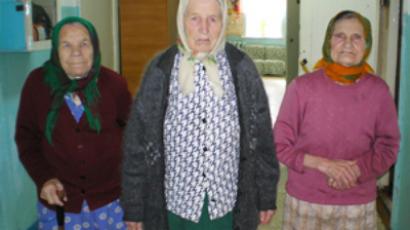
Activists from Nashi – a pro-Kremlin political youth movement – have stepped up their efforts to help Natalia Karpova, an 83-year old ardent admirer of Vladimir Putin, out of a mental institution.
Activists from Nashi – a pro-Kremlin political youth movement – have stepped up their efforts to help Natalia Karpova, an 83-year old ardent admirer of Vladimir Putin, out of a mental institution. Karpova has been admitted to “Kaschenko”, a notorious psychiatric hospital in Moscow, after stating that she had personally seen Prime Minister Putin at a national youth forum.
Karpova traveled to the forum in August to exhibit her artwork. Following her return, she told her friends at a nursing home about her purported encounter with Prime Minister Putin, who also happened to praise her art-piece.
Shortly after her story, Karpova was transferred to a mental facility. But Nashi youth activists allege that the real reason for Karpova’s institutionalization was her overzealous political activism.
In their official press release, Nashi activists describe Karpova as a respected and earnest member of her community. They also contend that Karpova did in fact encounter Prime Minister, and plan to provide evidence confirming the fact.
Nashists have also vowed to obtain an accurate medical diagnosis of Karpova’s mental condition, which could help the woman to be transferred back to her nursing home.

20.11.2009, 14:21
10 comments
Russia-Germany: strategic partners in Europe and AsiaRussian Foreign Minister Sergey Lavrov has met with his German counterpart, Guido Westerwelle, who is on his first official visit to Moscow. |
21.11.2009, 17:56
3 comments
United Russia party should change itself – Russian presidentRussia’s President Dmitry Medvedev and Prime Minister Vladimir Putin delivered speeches on Saturday at a congress of the pro-Kremlin United Russia party, which took place in St Petersburg. |
Marzipan6 First and foremost the Red Army is the greatest and bravest army in the modern history. This is a fact which cannot be refuted with any amount of historical revisionism. I have also noted that you have avoided responding to Estonia’s recent history pertaining to its role in participating in U.S illegal wars of invasion, occupation, extra ordinary renditions and torture. The soldiers who serve under George W. Bush had the misfortune of serving under a warmongering, neocon born again fundamentalist. Are you willing to condemn American soldiers who brought death and destruction to Iraq? I think not. Let me stress this point: the Red Army is a military force which fought with the greatest courage and bravery. You can say whatever you like about Stalin’s crimes but the Red Army won WWII despite Stalin. Eternal Glory to the Red Army
Sarah, I agree, the Red Army had an absolutely remarkable capacity to absorb suffering and still go on fighting. It’s just a pity (to put it mildly) that their sacrifices and suffering were betrayed by their political masters, who use them not to bring liberty to captive countries, but merely to replace a totalitarian Nazi regime of oppression with a totalitarian Soviet regime of oppression, with freedom not getting a look-in at all. As for how and why Estonia’s pre-war President died in Soviet captivity (as did, I believe, every member of Estonia’s government save one who managed to flee to Sweden), that is very simple. The Red Army invaded and occupied Estonia in 1940 at a time when Estonia was neutral and before Russia was at war with Germany. It arrested Estonia’s government members along with about ten thousand civilians (mostly women and children), and either killed them outright or deported them in cattle wagons to slave labour camps in Siberia, where most died. Or in the case of the Estonian president, to a psychiatric hospital in Russia, where he died. Google “Konstantin Päts”, “Estonia occupation” or “Baltic occupation”, and you’ll find more information about it than you can read in a week. You also ask, “Now, what is your view of Estonia participation in American war on terror, extraordinary renditions of Arabs and Muslims?” I don’t have a view on Estonian participation in the obscenity that is called “extraordinary rendition”, because there is and has been no Estonian participation in this. Also, Estonians participated in neither the invasion of Afghanistan or Iraq, but afterwards Estonian units have been posted in both places, to train locals and to protect them against armed insurgents. Numbers of Estonian soldiers have given their own lives in the course of these duties. Estonia cannot expect countries to come to its assistance in times of need if it does not do what it can to help others in their need.


Sarah, I thought I answered your question precisely and explicitly. What I did not answer was a question about the morality of the American invasion of Iraq. But that is not a question you asked. As for the Red Army, I did not refute the qualities which enabled it to be victorious. But I did point out that it was a victory and sacrifice betrayed inasmuch as it did not lift totalitarian oppression from Eastern Europe, but simply changed their totalitarian masters. If you want a more realistic, non sugar-coated picture of the WW2 Red Army, read Catherine Merridale’s recent book, “Ivan’s War: Life and Death in the Red Army, 1939-1945.” It does not deny the positive aspects of the Red Army, but fills in details which you omit in your post, and possibly also in your thinking. Here are a couple of dust-cover reviews of it: “Merridale’s new book is excellent. This unique, strikingly original account of the Red Army in World War II is a first-rate social history as well as an important military study, and a stellar example of the combination of oral history with standard archival research. It makes the soldiers of the Red Army come alive” (Stanley Payne, Professor of History, University of Wisconsin-Madison). “Catherine Merridale has done something very unusual. The Soviet war effort has been described many times but her new book tells the searing story from the bottom up. Her account of the sufferings of the Red Army soldiers and their families is unlikely to be bettered” (Robert Service, author of “Stalin” A Biography”).