Hungary equates Communism to Nazism
Published: 10 June, 2010, 23:00
Edited: 23 June, 2010, 03:07
TAGS: Conflict, Politics, Europe, Human rights, Law, History
Hungarian lawmakers have passed a bill equating Communist era crimes to the Holocaust and banned denying it under threat of imprisonment.
An amendment to the Criminal Code was passed by the parliament’s majority center-right party FIDESZ (Hungarian Civic Union) on Tuesday, Itar-Tass reports. According to the new legislation, those denying, casting doubts on, or depreciating the crimes committed by the Communist regime will be facing from one to three years behind bars.
Earlier, in February this year, the former coalition of the left wing parties passed a law banning the denial of the Holocaust. Now the rightists – who won over 68% of seats in the parliament in spring 2010 – have struck a balance between Communism and Nazism. The decision is among the first crucial ones made by the Hungarian Civic Union since it came to power.
Russian Communists have labeled the decision as a provocation and said it is disreputable for a parliament to do so.
According to Communist Party leader Gennady Zyuganov, the move is an echo of the Nazi regime, which terrorized Europe in the 1920s and 1930s.
“Back then, 23 European states were ruled by the Nazis and pro-Nazi regimes and Hungary was Hitler’s first accomplice,” he said in an interview with Echo Moskvy radio station. “This voting is a 100% provocation which humiliates our fathers, the victors of WWII. In the year of the 65th anniversary of the victory I consider it to be not just a provocation but a sign of a Nazi plague which is spreading across Eastern Europe,” Zyuganov stated.
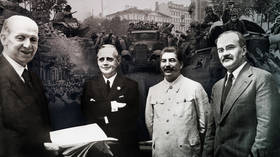
In its history, Hungary experienced living under both the Nazi and Communist regimes. During the Second World War the country was a member of the so-called Axis powers. Collaborating with Italy and Germany back then, Hungary benefited territorially. Fighting on the Nazi’s side, the Magyars took part in the invasion of Yugoslavia and the USSR.
After suffering tremendous losses in the battle of Stalingrad and realizing Hitler would likely lose the war, Hungary got involved in talks with Western allies in 1944 to seek an armistice. As a result, however, Hungary – which turned from Hitler’s friend into foe – was occupied by the German forces. Under the occupation, up to 500,000 Jews living in Hungary died from maltreatment or were murdered. Only about a third of the Jews who lived in the country before the war survived the Holocaust.
After the war came the years of the People's Republic of Hungary and the Communist regime. In 1956, a student rally demanding reforms and political freedom led to a chain of events that resulted in what is known as Hungarian Revolution. The revolt was suppressed by Soviet tanks and troops which entered the country at the request of the Hungarian Working party. As a result, thousands of Magyars were killed and up to 200,000 Hungarian refugees fled the country.
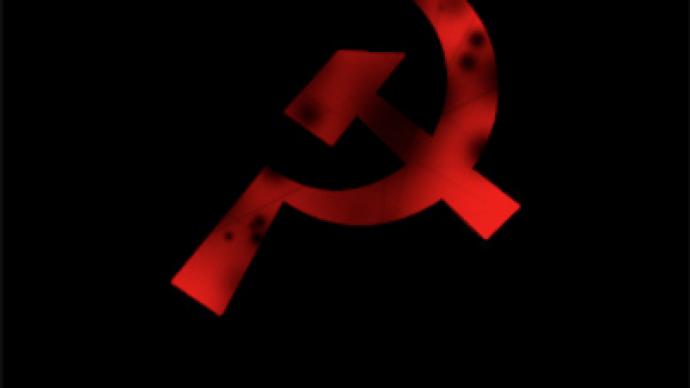
The idea of equating the Nazi and the Communist regimes is not new for the former Iron Curtain states. In November last year, Polish President Lech Kaczynski approved an amendment to the criminal code which outlaws the production, possession, spread and sale of items or recordings containing symbols of communism. A year before that a similar law was passed by the Lithuanian parliament which banned the display of Nazi and Soviet symbols, such as the swastika and the hammer and sickle.
Natalia Makarova, RT

10.06.2010, 16:45
5 comments
ROAR: “Iran is interested in cooperation with Russia despite sanctions”Tehran may react differently to Russia’s and China’s support for the fourth round of sanctions adopted by the UN Security Council, analysts say. |
11.06.2010, 11:23
4 comments
Russia discusses security and war on drugs with Shanghai partnersPresident Medvedev is in Uzbekistan attending a two-day summit of the Shanghai Cooperation Organization (SCO). Kyrgyzstan’s unrest and Afghan drug trafficking are among the issues at the top of the agenda. |
Svetlana, do I detect another person without difficulties in reading? I wrote about Soviet State and not Russian people. I fail to understand your post. People travelled to Leningrad because: 1) There was cheap vodka (lots of Finns have a drinking problem I agree) 2) It was interesting place to see how people in so different country lived (I was one of these) 3) Trips were cheap (Finland was a poor nation for 30 year after the war) 4) It was very much sponsored by labour unions and political parties at the time (There were lot of communists in Finland) Lot of Finnish speak Russian. Why shouldn't they want to talk in Russian? We don't hate Russians. We don't start to complain to a Russians about problems with Soviet Union at least before we know them. Finns are quite polite and reserved people generally. But ask them next time what they think about Stalin and you might get some light in the situation. Also one good reason is that Finns were thought in the Sovietic time that there's never anything wrong with SU, only peace and cooperation. No critical words were allowed by Finnish self censorship by most of the media. Some parties didn't get to government because of "yleiset syyt" (Common reasons). Everyone knew this meant that SU didn't approve them, but it couldn't be said aloud. Kekkonen was in power so long he was already demented because he was thought to be the only person to keep Finland independent with his good relations to Kremlin. This kind of false reality we were living in made the more simpler people actually believe in these half truths.
Sorry for not replying for a while. Just back from Russia. Again basically met only nice people there. Even lost my bag with passport and money (no drinking involved here! ;) and it was found fully untouched! Larry, where did I lie? I wrote that Finns fed them by best of their abilities and didn't deny anywhere that many died. I don't know if your numbers are right or not though. But, Finland was nation in war at that moment and as basically all the men were at war and 10% of farming area was lost in Winter War, Finland couldn't even feed it's own people without getting crops from Germany. So I don't see it as a big surprise that the prisoners weren't in the top priority to be fed. But this was again because of Soviet's aggression. But I don't see any problem saying that I'm sorry for these people's deaths and suffering, if it makes you happy. Can you do the same for Soviet's actions in two war it started against Finland? SU's bombing the civilian targets, including all the major Finnish cities, taking over 10% of Finnish land, partisan attacks against civilians, causing by starting the war deaths of tens of thousands of Finnish soldiers and wounding many more, causing huge economical problems by destroyed Finnish infrastructure and in paying the war reparations? And 45 years of tight rope balancing because of a real danger that Finland would be turned in to one more Sovietic country if it just said one thing wrong. And what comes patriotism, I don't consider myself patriotic person. I value freedom, equality and justice as important things in my life. I'm commenting here only because I wanted to correct some misinformation about about Finland as I happen to know more of that subject as some others.


And one more additional point to Larry, as you like the Wikipedia. Just finished reading the article about continuation war: http://en.wikipedia.org/wiki/Continuation_war There's also written about Finns who were punished after the war because of their claimed actions in the camps: "After the war, based on the testimonies of the former prisoners of war, criminal charges were filed against 1,381 Finnish camp staff, resulting in 723 convictions and 658 acquittals. They were accused of 42 executions and 242 murders. There were 10 cases of death from torture, eight infringements of property rights, 280 official infringements and 86 other crimes." So here I think is quite clearly shown that the Finnish paid the price of their criminal actions. Case closed on this. But when do we see the some of the Soviet war criminals (talking about Winter war and Continuation war here) on trial and not celebrated by Soviet successor state as heroes? And when will the Karelia and other areas be returned to whom it was taken by force? Probably never. And that is sad not only for Finns but in the long run for the Russians too. Have you seen what is the condition of Viipuri (or other towns in occupied areas)? It is extremely sad place to visit. Maybe the city is feeling better now when it has been named for some military glory award by Medvedev. The knowledge of Russian president about history seems to come from some old Soviet school books.