From oranges to rotten eggs: Ukraine and Russia enjoy new dawn
Published 27 Apr, 2010 14:59 | Updated 2 May, 2010 08:30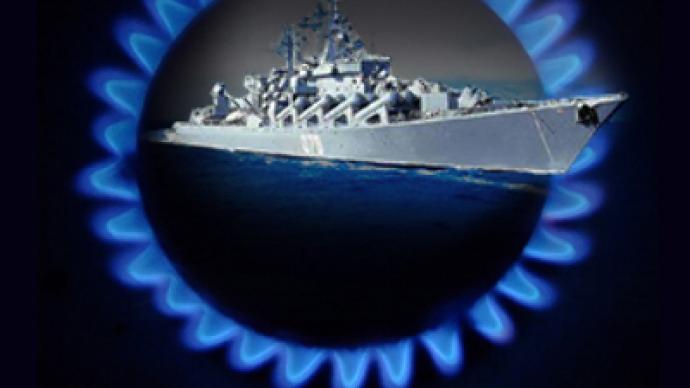
In just over half a decade, the Russian-Ukrainian relationship has come full circle, culminating in Kiev’s decision to allow Russia’s Black Sea Fleet basing privileges until at least 2042.
Just five years ago, Viktor Yushchenko was delivered to the highest office in Ukraine atop the wave of a bloodless uprising known as the Orange Revolution. Yet what was hailed as a brave new day for the Ukrainian people, with the West serving as a lighthouse in a sea of troubles, was quickly betrayed as a political agenda constructed on nothing more lasting than shallow nationalism and, some would argue, latent anti-Russian sentiments.
Thus, practically from the moment of Yushchenko’s inauguration in 2005 until late 2009, Kiev and Moscow were embroiled in one bitter standoff after another. The most memorable tiffs involved some aspect of Ukrainian gas deliveries, much of which (should) bypass the country on its way to Russia’s European customers.
During Yushchenko’s term in office, Russian gas deliveries to Europe were disrupted on two separate occasions over the question of how much Ukraine should have to pay for its supplies. Kiev and Moscow defused what could have snowballed into an international disaster following emergency meetings between Russian Prime Minister Vladimir Putin and his Ukrainian counterpart, former Prime Minister Yulia Timoshenko. Unfortunately for Russian-Ukrainian relations, the hostility between the two historically connected nations, much more brothers than cousins, continued to worsen.
Finally, in the dog days of last summer, against the backdrop of a relentless NATO advance, aggravated by a visit to Ukraine by Patriarch Kirill, the head of the Russian Orthodox Church, and topped off with threats that Russia’s Black Sea Fleet would be served its eviction papers after its rent terminates in 2017, President Dmitry Medvedev shot back with a fiery letter, upbraiding Kiev’s “anti-Russian course.”
After reciting a long list of grievances, the Russian president ended his letter by saying “It is unacceptable to subject centuries-old relations to such serious tests for the sake of short-term developments, thereby encouraging younger generations to harbor a mutual grudge by playing with nationalist complexes.
In Russia we hope that the new political leadership of Ukraine will be ready to build relations between our countries that correspond to the genuine aspirations of our peoples and help strengthen European security.”
Moscow finally got the partner it was hoping for with the election of Viktor Yanukovich, in a hotly contested presidential election against Yulia Timoshenko, the golden-braided oppositionist whose ability to arouse the masses seems to have lost all power, probably due to her political proximity to Yushchenko.
Yanukovich eggs on the opposition
Last week in Kharkov, the former capital of Ukraine, Viktor Yanukovich and Dmitry Medvedev met for a series of talks aimed at healing the bilateral discord sowed by five years of bad blood.
“Today, we will summarize difficult negotiations that we were conducting recently and related to overcoming the crisis in the economy, putting relations between Ukraine and Russia on a long-term strategic common ground,” Yanukovich told reporters.
Speaking on the subject of Russia and Ukraine’s historically low level of relations, Yanukovich said this was not a recipe for success.
“We could never imagine such a thing happening in our history,” he added, noting that such a controversial atmosphere does not correspond with the mood of the people in Ukraine and Russia.
“Our people want us to build the traditionally friendly relations that have always brought our peoples success,” he said.
The atmosphere of goodwill between Medvedev and Yanukovich allowed the two leaders to hammer out the details of a plan that provides Ukraine with 30% cheaper gas supplies in return for extending Russia’s leasing rights for its Black Sea Fleet in Sevastopol until the 2042, with an option to extend it for an additional five years.
Where the rent money goes
Ukraine will obligated to transfer the money it saves from the recently agreed gas discount to a special account used to hold the rental income Russia pays for basing the Black Sea Fleet at Sevastopol, Russian Energy Minister Sergey Shmatko told journalists.
That commitment is stipulated in the intergovernmental agreement on the fleet's basing.
The rent on the Black Sea Fleet will be paid beginning May 28, 2017.
The gas discount, which amounts to 30% of the price but no more than $100 per 1,000 cubic meters, goes into effect this year.
“The additional funds from the discount are subject to accounting on an accrual basis and constitute Ukraine's direct international responsibility to Russia,” Shmatko said.
All of the savings from the discount are to be sent to the fleet basing account.
“All of the funds that will be saved are accounted for in the settlement for our base,” Shmatko said.
The idea is so simple, and contains so many mutually advantageous features, that it is understandable why the Yushchenko presidency could not stay afloat: it was trying to swim against the current of what are arguably the only realistic parameters for not only successful Ukrainian-Russian relations, but Ukraine’s very economic survival.
Presently, Ukraine finds itself in the same boat as Russia: until both countries successfully diversify their economies, they will necessarily remain overly dependent on natural resources to pay the bills. But for Ukraine, which is fishing for a $12 billion loan from the International Monetary Fund, the situation is much more urgent. Yushchenko, blinded by his nationalistic passions, ignored this dilemma to the detriment of his nation’s economic wellbeing.
Indeed, Yanukovich justified his deal with Dmitry Medvedev on purely economic grounds.
“This decision will give us the chance of really helping our economy. We have boosted confidence in the economy,” he said.
With memories of a government-toppling revolution in Bishkek still fresh in mind, and to a less-dramatic degree, the current economic woes of Greece, a NATO member incidentally, it becomes easier to see the practical wisdom of Yanukovich’s decision. Now, the new government will not be forced to raise the price of gas for households and public utilities. This will certainly be greeted by all Ukrainians, regardless of their political colors at a time of economic uncertainty.
Yet in Kiev, political passions are known to occasionally cloud good economic sense.
As the vote to extend Russia’s leasing rights for its Black Sea Fleet won ratification by 236 votes in the 450-seat legislature, the Rada – Ukraine’s parliament – erupted in total chaos, with opposition lawmakers hurling eggs and smoke bombs at their opponents. Perhaps rain was forecast in Kiev today, or Yanukovich’s supporters were expecting trouble, because dozens of umbrellas popped open to shield the speaker from the egg bombardment as he read out the law amidst the confusion .
For the Russian side, the Ukrainian opposition’s heated response to the decision was greeted more with curiosity than animosity since even Yulia Timoshenko was prepared to discuss an extension for the Black Sea Fleet. The only hitch, according to Vladimir Putin, was the price.
“I have read the Ukrainian press, and I see that a debate in the Rada is going to be tense. It is a little bit unexpected to me because we discussed the matter with the previous government in previous years, and then no one was opposed to the extension of the Russian Black Sea Fleet's presence,” Putin told reporters in Kiev.
“The issue has always been raised in a different way: nobody, even Yulia Vladimirovna [Timoshenko] refused to discuss the possibility of the extension, the point at issue was only the price,” the premier said, adding, “But the price they offered us was exorbitant.”
Putin then resorted to his trademark colorful language to drive home his point.
“For this money I would eat both Yanukovich and your premier together, but I cannot – not a single military base costs that much,” Putin said. “If we calculate it, then this contract comes to $40-45 billion in 10 years.”
“It is possible to build several such bases with this money,” the prime minister added, before reminding his audience that the most important thing was good neighborly relations with Ukraine.
“For us it is not only a matter of money, but also cooperation, and cooperation in the military sphere builds up confidence between states.”
The Russian prime minister then stressed the economic advantages of having the Black Sea Fleet in Crimea, arguing that Ukrainian shipbuilding enterprises would stand to gain from future contracts.
“If the fleet stays after 2017, this means that we will be loading shipbuilding capacities of Ukraine, including with capital repairs and general work with our fleet.”
Putin stressed that such construction jobs would be “our joint work.”
Russian President Dmitry Medvedev backed up Putin’s comments, admitting that the cost to maintain the fleet is “great,” but reminding that it promotes the security of both Ukraine and Russia.
“The price we are paying for the fleet is great, but it is not out of proportion, this is so because we have strategic relations with Ukraine, and we hope that such relations will last. Ours are centuries-long bonds and they imply mutual assistance. The presence of the Black Sea Fleet promotes the security of Russia and Ukraine and makes a contribution to European security,” the president told reporters.
Meanwhile, Yanukovich, who is in Strasbourg today, addressed the Parliamentary Assembly of the Council of Europe, announcing that Ukraine cannot join the Customs Union of Russia, Belarus and Kazakhstan because it is a member of the World Trade Organization (WTO).
“Ukraine has made its choice and joined the WTO,” he said. “We have integrated into the WTO and are developing in line with principles of this organization. Therefore, joining the Customs Union of Russia, Belarus and Kazakhstan is impossible."
According to Yanukovich, Ukraine will seek a comprehensive economic partnership with the European Union.
This statement proves that the Ukrainian leader is truly working on behalf of the Ukrainian people, and not simply for a narrow political agenda.
Robert Bridge, RT and Evgeny Sukhoi, RT