VERSIONS: روسيا اليوم NOTICIAS FREEVIDEO ИНОТВ RTД
breakingnews
Go to main page   Politics   US breakup: Myth or reality?  
MORE ON THE STORY
St. Petersburg, Russia: Heads of Eurasian Economic Community member states at a joint press conference on October 19, 2011. (RIA Novosti / Aleksey Nikolsky) 21.10.2011, 15:17 13 comments

The EU is dead: Long live the new EU

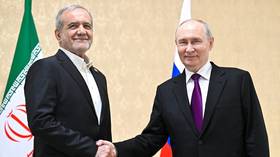
The creation of the Eurasian Union (EU-2) as recently mooted by Vladimir Putin could become an integral idea for Russia and allied nations of Eurasia. Writer and political scientist Igor Panarin says the concept might become reality as early as 2016.

US Republican presidential hopeful Rep. Ron Paul (AFP Photo / Nicholas Kamm) 18.10.2011, 00:30 29 comments

Ron Paul reveals plan to save $1 trillion

With the United States only going deeper and deeper into debt, GOP presidential hopeful and Texas Congressman Ron Paul says he can cut spending by $1 trillion during his first year in the oval office, according to a new economic outline.

US Election 2012
Demonstrators with 'Occupy Wall Street' protest at Zuccotti Park in New York on October 13, 2011 the day after Mayor Bloomberg gave a message to Occupy Wall Street protestors that the park needs to be cleaned. (AFP Photo / Timothy A.Clary) 14.10.2011, 11:15 6 comments

Globe against the greedy: protests spill worldwide

Protests against economic mismanagement and corporate greed are going global. In addition to the Occupy Wall Street movement sweeping the US, protesters from over 70 European and Asian nations are set to hold co-ordinated mass rallies on October 15.

Eurozone crisis Occupy Wall Street

US breakup: Myth or reality?

Published: 27 October, 2011, 20:31
Edited: 18 January, 2012, 14:15

The overlapping financial, economic and social challenges may eventually cause the world’s strongest superpower of the 20th century to collapse, Russian political scientist Igor Panarin believes

The overlapping financial, economic and social challenges may eventually cause the world’s strongest superpower of the 20th century to collapse, Russian political scientist Igor Panarin believes

TAGS: Crisis, Politics, USA, Economy


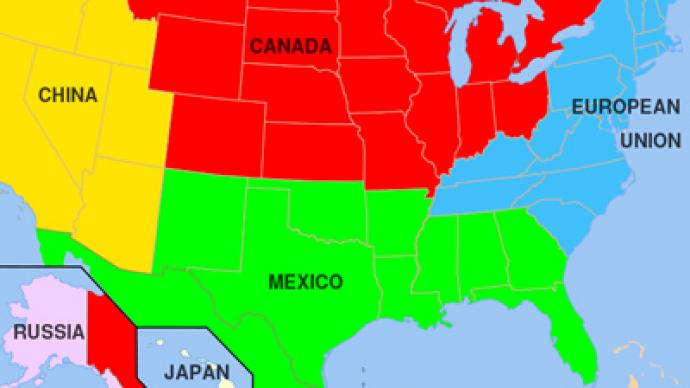
The US might collapse into six pieces, according to a theory proposed by Russian political scientist Igor Panarin. And the current economic crisis in the country, amplified by mass protests, might be the beginning.

­In the article below, Panarin explains his view.

The enormous foreign debt ($15 trillion), the huge budget deficit ($1.5 trillion), and the growing number of social protests indicate that my assumption of the US breaking up into six parts is still relevant.

On September 9, 1998, I first voiced my hypothesis of the possible disintegration of the US into six parts in 2010, at a conference named “Information War” in the Austrian city of Linz. The primary reason, as I said then, would be financial and economic problems.

2010 is of course long gone, but the US is still alive and kicking. Is it time to dismiss my 2010 hypothesis as irrelevant? Apparently, no. Time has shown that the US still cannot solve the problem of its foreign debt. When I addressed the Linz conference, it was $2 trillion; now it’s $15 trillion, which means that it soared more than 7 times within 13 years. It’s a road to nowhere because the country will never be able to pay it off. Here’s an example: During the 6 years of Gorbachev’s rule, the Soviet Union’s foreign debt grew fivefold, and earlier, during World War I, the foreign debt of the Russian empire grew 5.5 times. This, among other reasons, was enough to prompt a collapse of the Russian Empire and the Soviet Union.

Barack Obama was elected president amid public discontent with the policies of George W. Bush and the outbreak of the global financial meltdown. The decisive thing behind his victory in the election (he beat John McCain by just 7.5 per cent of the vote) was Americans’ hopes for positive changes. These expectations were aptly exploited in Obama’s campaign as the slogans of “Hope” and “Change.” That is why grassroots Americans viewed Obama as a man who could lead the nation out of the crisis.

Several years have since passed, bringing little to no change. Many of the Obama administration’s moves to speed up economic recovery after the 2008 crisis have failed. Thirty-eight US states had a budget deficit when Obama started his term in office, and the number has grown since. Forty-nine US states are now suffering from a budget deficit. Five times the number of banks that went bankrupt in 2008 threw up the white flag in 2010.

My forecasts seem to be coming true. The number of people forced to use food stamps in the US keeps growing: it grew by 74 per cent over the past three years. Unemployment is growing, too. All of this is fuelling protest moods among the people (a case in point being the Occupy Wall Street protests that have spread to almost all US states).

Mass protests in the US began on September 17, with a crowd attempting to picket the New York Stock Exchange. Since then, the movement against social injustice and corporate greed called Occupy Wall Street has spread to dozens of US cities and even to other countries. Up until quite recently, the protests across the United States were relatively peaceful, but October 25 saw mass clashes with the police in Oakland, California, where riot police moved in to tear down the protesters’ tent city. The police used tear gas and were altogether tough in handling the protesters. The Oakland scuffle was followed by a similar crackdown in downtown Atlanta, Georgia, where the police ripped down over 75 tents and arrested some 100 activists.

Among other things, the protests in the US have highlighted the ever-deepening split within America’s ruling elite, which was made explicit during the US debt-ceiling crisis that preceded the signing of the Budget Control Act on August 2.  Many of the OWS activists are also Democrat supporters who backed Barack Obama during the last presidential election. As for the president himself, Obama unleashed stark criticism of Wall Street and the Republican-dominated Congress during an appearance at the University of Colorado, Denver, on October 26.

The overlapping financial, economic and social challenges may eventually cause the world’s strongest superpower of the 20th century to collapse.  

Remarkably, a number of analysts in the United States share this opinion. Gerald Celente predicts a disintegration of the US in 2012, while Stephen Cohen projects a similar outcome for 2013. Military analyst and Vietnam War veteran Thomas Chittum warns that the United States could face Balkanization and a “second civil war” based on racial conflicts by 2020.

­Professsor Igor Panarin, Dean, Diplomatic Academy, for RT.

­The statements, views and opinions expressed in this article are those of the author and do not necessarily represent those of RT.


+37 (51 votes)
 
Back to top
next MORE NEWS
RIA Novosti / Valery Melnikov 27.10.2011, 17:27

Kremlin blasts Luzhkov’s repression claims as absurd

Dmitry Medvedev’s press secretary has branded claims by Moscow’s former mayor, Yuri Luzhkov, that he was being persecuted by the authorities as absurd.

RIA Novosti / Vitaly Ankov 28.10.2011, 14:11 5 comments

Big government goes online

A website is being launched which will allow every Russian citizen to become a participant in an extended government.

nazdaro March 07, 2012, 06:50
+1

Hello Russia, EU, China. Doesn't sound familiar?... Everyone of you went through the conspiracy at the time to muzzle you: Communists, WWI, WW2, whatever turmoil was fabricated to bring your countries to their knees! Now saddly it's the turn of the USA, which was the only country who prevaled against the Demons of the time. Always watch  & ask what are the interests of each action/group/politicians/actors/talk-shows/religious/allies dragging Us in a suicidal war... before you condamend a country. Every American Citizen Should Read Entirely The Constitution Ammendmends Before Making A Judgement.... Our Founding Fathers knew about human cupidity and made the Ammendments to worn us,... This Country Belongs To us,  & "not we are you and you are us, Kapich!!!"

Corvus Rabiatus February 19, 2012, 10:38
+1

My suggestion for the capital of the Canada/Mexico.US federation, would be either Chicago, or Minneapolis/St.Paul, or maybe even Denver.

These are all conveniently central, well connected (in the data-communication sense) and less than vulnerable to external threats. (Like Moscow is, in the Russian Federation.).

Becoming tri-lingual (instead of de-facto bi-lingual) could be a problem, but it might elevate the American education system to something more useful than it is today.


Corvus Rabiatus February 19, 2012, 10:21
+3

Interesting idea, but a little simplistic and not taking physical boundaries into consideration. Unlike most, I do not think that the  Mexican part is all that preposterous. Mexico has very successfully managed its propaganda in order to project itself as being less powerful and less prosperous than it actually is.

The Chinese, Japanese and Russian dominated zones are ridiculous flights of fancy, as is the European one. There is not a single significant indicator that the EU is even remotely interested or inclined to get involved in this. I would sooner see a 'home-grown' societal adjustment towards the European model, as is currently underway in the state of Vermont (and to some extent in Minnesota).

Personally, I would not mind an overall inclusion of the current

'Blue-States' into a coalition with Canada and under Canadian legislation and law.

Adding it all up, I would see a possible Canada/Mexico split-up or even an eventual total federation of the US, Canada and Mexico into a social-democratic model with a parliamentary system, so that the two-party alternating dictatorship model will be a thing of the past.

Then again, I'm not an American and frankly speaking, quite happily so.