VERSIONS: روسيا اليوم NOTICIAS FREEVIDEO ИНОТВ RTД FIND US ON: YouTube Twitter
breakingnews
Go to main page   Politics   Putin’s plan – a strong democratic hand  
MORE ON THE STORY
26.12.2006, 11:20

Life sentence for Beslan terrorist affirmed

Russia’s Supreme Court has affirmed the life sentence for convicted terrorist Nur-Pashi Kulaev, the only surviving militant involved in the 2004 Beslan tragedy. Many relatives and victims of the massacre say the ruling was insufficient.

Flowers in memory of the Beslan victims 01.09.2007, 20:32

Beslan remembers school siege

September 1 is a day of mourning in Russia’s southern Republic of North Ossetia. It marks the moment three years ago when terrorists seized control of Beslan's School Number One. More than 1,200 children, teachers and parents were taken hostage. 334 of

Women mourn inside the Beslan school gymnasium on September 1, 2009 (AFP Photo / Kazbek Basayev) 03.09.2009, 20:14

Memorial services mark Beslan siege

It is five years since the school siege in the Russian town of Beslan came to an end with a bloody battle. The third of September marks the end of the three-day siege.

RIA Novosti 06.07.2010, 16:51 3 comments

Time to break stereotypes over North Caucasus – Putin

The image of the North Caucasus should be changed for the better both in Russia and abroad; phobias and stereotypes should be overcome, Premier Vladimir Putin has said at the ruling United Russia faction’s conference.

12.10.2009, 02:42 5 comments

First post-Soviet local elections held in Chechnya

Among other Russian regions, polling stations have closed in Chechnya where people have cast ballots in municipal elections for the first time since the Soviet era. Voter turnout is reported at over 80 per cent.

09.10.2009, 15:49 2 comments

Russia ready for major election day

October 11 will be the next election day in Russia – on Sunday millions of citizens will be able to vote for deputies of local legislatures throughout the country.

Image from nebuchadnezzarwoollyd.blogspot.com 25.09.2009, 09:52

Dagestan: ten years since bloody assault

It has been ten years since Chechen terrorists invaded another Russian republic of Dagestan, hoping to win the support of the population in a bid to establish a joint Islamic state. Instead they faced harsh resistance.

03.09.2009, 11:40 14 comments

N. Caucasus violence masterminded by foreign security services?

International terrorism is an international question, not just a problem of internal security, believes Giulietto Chiesa, an Italian journalist and Member of the European Parliament.

RIA Novosti / Said Tcarnaev 23.10.2010, 12:20 6 comments

"Caucasus is the foothold of Russia"

The deputy head of the Russian President’s administration, Vladislav Surkov, has spoken about the significance of the Caucasus for Russia during his visit to the Chechen Republic.

Glory Memorial blast in Kutaisi (RIA Novosti / David Hizanishvily) 22.12.2009, 21:21 55 comments

WWII memorial blown up in Georgia to be rebuilt in Moscow – Putin

The memorial to WWII veterans that was demolished in the Georgian city of Kutaisi earlier this month will be rebuilt in Moscow, Russia’s Prime Minister Vladimir Putin has declared.

Putin’s plan – a strong democratic hand

Published: 11 September, 2009, 17:16
Edited: 15 September, 2009, 08:02

TAGS: Election, Putin, Chechnya, Russia, Politics


Five years ago, Vladimir Putin announced a reform of election law. This elapsed period allows us to make the first conclusions about the effectiveness of the reforms and also have a deeper look at the motives for them.

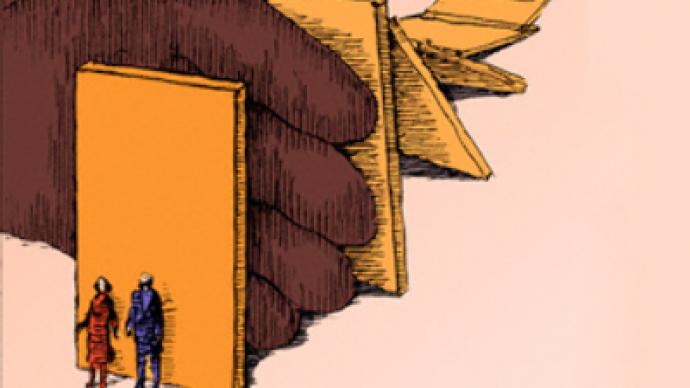
On September 13, 2004, Russian political development took a sharp new turn – then-President Vladimir Putin announced that special measures would be taken to enforce the fight against terrorism and to centralize power in the country. With a number of decrees, Putin abolished gubernatorial elections in the Russian regions and ordered that top regional officials must be appointed by the President and approved by local legislatures (with the President having the right to dissolve a legislature after two consecutive refusals to approve a candidate favored by the Kremlin).

The Russian press generally saw (and continues to see) the move as a reply to the school siege in the southern Russian city of Beslan in 2003. Foreign political analysts and Putin’s opponents at home called the reform a blow to the young Russian democracy. Here I would like to have a closer look at both points.

The hostage taking in the School No. 1 in the North Ossetian town of Beslan took place on September 1. A group of terrorists held over 1000 people hostage demanding the withdrawal of federal troops from Chechnya and the release of Chechen militants detained in previous clashes. Three days later, Russian Special Forces commenced an operation to free the hostages, killing all but one of the terrorists. Unfortunately, over 350 civilians were also killed, making the Beslan school siege the worst terrorist attack in modern Russian history. However, while it is obvious that Beslan was a trigger for Putin’s reforms, it is important to understand the overall state of security in Russia at the time.

In May 2004, a bomb planted in the concrete pillars of a stadium killed the pro-Kremlin Chechen President Akhmad Kadyrov and about 30 other people. In June, a large group of militants attacked the Russian republic of Ingushetia, killing about 100 people. In August, Chechen suicide bombers detonated explosives on board of two Russian passenger aircraft, killing 43 and 46 people. Also in August, a bomb exploded near a metro station in Moscow, killing 10.

It is clear that the situation all over the country was extremely tense (although the situation in 1995 and 1996 was possibly even worse, with Chechen terrorists staging attacks and hostage takings not only in Russia, but also abroad). Thus, the solution to the problem had to be sought on a nationwide scale, which was proposed.

We should also remember that 2004 was the year when Putin was elected for his second presidential term. The re-election showed Putin’s extreme popularity, but it also showed that voters liked Putin’s personality and his way of decision making, not the rather vague program that he offered (several years later, when the pro-Kremlin United Russia heavily used the term “Putin’s plan” in its election campaign, it became very clear that there was no plan as such, but rather a general line Putin had chosen for development). But such a scale of nationwide belief in Putin’s personality also meant a great deal of personal responsibility. And personal responsibility is something which is very difficult to share, especially when one cannot choose the people to share it with.

On the other hand, the move was of course a blow to democracy, but not exactly as Putin’s critics see it, i.e. the president grabbing all power he could get, rather in a more indirect way. Putin’s reforms were giving in to the age-old tendencies of the majority of Russian population to rely on a central power, preferably personified by a single man. Regional elections gave the country local leaders who were less dependent on Moscow, but they also provided Russians with basic training in politics and showed how democracy could immediately affect one’s life. But by voting for Putin’s second term, Russians made it understood that they preferred someone else to take responsibility, especially when the decisions were difficult. And as we saw before, the situation in 2004 required tough decisions.

Another thing which is often overlooked is that, along with the changes in regional elections, Putin proposed an unquestionably democratic move – to set up a Public Chamber with the President. This is a special advisory body comprised of 126 people from political, public, cultural and religious organizations. Thus, by taking more responsibility, the President also promised that the decisions would be more evenly-weighted and that the public’s wishes and hopes would be delivered to him, even though he personally appointed one third of the members of the chamber and the appointees in turn elected the other two thirds.

If the intervening years since the reforms were enacted show anything, it’s that the Russian people are not, on the whole, terribly fazed by the alleged removal of certain democratic opportunities, namely the right to vote for their governors. The popularity of the previous and current administrations remains at levels most other countries’ leaders could only dream of. Russians approve of these measures.

Moreover, to judge the effectiveness of the reforms themselves, we should look at the current situation in the country. We see that the number of terrorist attacks has decreased and also that, instead of blasts and hostage-takings targeted against civilians, terrorists choose government and law enforcement officials as their victims, thus showing that Moscow is choosing the right people for the task, after all.

Kirill Bessonov, RT

+24 (28 votes)
 
Back to top
next MORE NEWS
Vladimir Kremlev for RT 11.09.2009, 16:12 3 comments

ROAR: “Georgia has no levers to punish Chavez”

More countries may recognize the independence of Abkhazia and South Ossetia following Hugo Chavez’s example, Russian observers think.

Russian Federation, Alagir: Children from South Ossetia wait in a refugee camp on August 11, 2008 (AFP Photo / Natalia Kolesnikova) 12.09.2009, 07:18

“Georgia’s initiative on Abkhazian and South Ossetian refugees purely political”

The Georgian initiative on refugees and temporarily displaced persons from Abkhazia and South Ossetia has nothing to do with humanitarian objectives, said Russia’s Foreign Ministry spokesman, Andrey Nesterenko.

007 September 13, 2009, 21:29
0

One look at this crazed world, which is at low intensity war, and you know Putin’s decision to concentrate political power and centralize democracy, is the right one. If the Kremlin now makes sure that economic benefits are pushed down to its electorate, and that the Kremlin does not now also own every Cheese, Coffee, and Grocery store, I’d be happy to call this a working centralized democracy. I far prefer this to the American Pecuniary Monarchy, were King Bernanke and Queen Geithner of the “FED of Bandits”, appoint puppet presidents who then wave at the people in alien populist media. When 2% of the USA loyal to another country, owns 95% of the USA, all of whom have been made wealthy by the FED of war mongers printing America’s money to enrich the few… this is not democracy, it’s the “democratic” union of daylight robbery. I don’t care if Russia’s wants to make Medvedev the new Tsar, Putin its King of Due Diligence and let people vote for the Central Bank Governor, that is better than the Private Central Banker Money Priests of Armageddon we now have running our planet in the name of “democracy”. Why pretend “democracy” as dictated by central bankers works for anyone other than central bankers… it’s about time a country got honest and did something for its people, and if that is why Russia is now your enemy, then you are going to have to fight the whole world. If countries are not fighting for our emancipation from alien central banking tyranny, then just get it over and done with, do the inevitable, destroy the world, because this hellhole is then no longer redeemable. Look at our private central banking world… its hell… I say, Russia, do whatever works… western “democracy” is a lie.

Bianca September 13, 2009, 03:51
0

Very informative article. Keep up with giving such really detailed information on the actual workings of institutions, it was a treat. I would like to venture a few comments. It is perhaps, from a different cultural perspective, if I may. I would not say that the changes were "a blow to democracy, of course..." There is really no known model of democracy that I know of, that can be used as a template, and then if other models do not match, say "... of course, it does not fit". I would say that the model of appointing governors is accually very good for Russia's overall structural organization, its territory and wide gaps in the different levels of economic growth. This cannot be compared with US model, because US is a union of States. However, in practice, since federal government now finances a great part of State budgets, it is often irrelevant who the Governor is. So, unless we know more about the local government practices, as well as the sources of finances, we cannot really ever say "... of course..". And definitely, changes that in the long run demonstrate their value, cannot be called "a blow to democracy"! If we are to use such terminology, I would suggest that we look at Putin's critics and all the ideas. Let us see, now with the benefit of the elapsed time, how well would have their ideas withstood the wear and tear of time? I remember quite well the cry of democratic forces when the discussion was held on the wisdom of setting up Reserve Funds, and subsequent division into two funds. I remember all the reasons of the free market gurus that claimed that this was a terrible idea. The time has proven conclusively that having savings was the key to survival, while excessive debt was a cause of financial crisis. There are other such examples. It would be fun reviewing some of those, as it could be a great lesson in keeping an open mind.