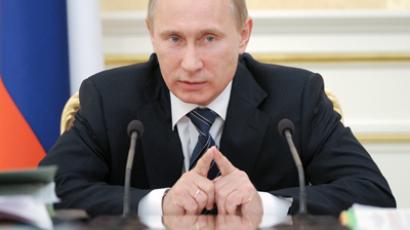
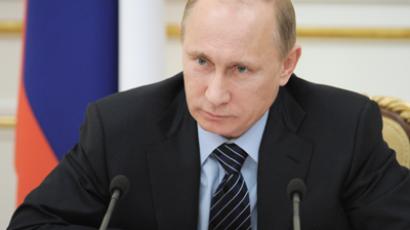
Putin releases manifesto for economic revival
Published 30 Jan, 2012 03:59 | Updated 30 Jan, 2012 18:49In his third article in as many weeks, Prime Minister Vladimir Putin provides his views on a rapidly changing global economy, and what Russia must do to stay in the race.
The piece, published on Monday in the newspaper Vedomosti, provides a multifaceted look at the global economy – from the shakeup in the role of global leadership, to the hazards of a deteriorating natural environment – and aims to prove that Russia will be in competent hands should voters deliver Putin back into office on March 4.Opening his article by mentioning the “radical economic change across the globe,” compounded by “rapid technological advances,” Putin admits that mankind is vulnerable to “technological disaster” and “environmental hazards” However, he remains optimistic that mankind will ultimately beat the clock against the threat of imminent disaster given that “human capability is so vast.”Putin then throws down the gauntlet to the nation with a challenge that frames the article’s central premise: “Those who apply the new capabilities to the fullest extent are the ones who come out on top.”Clearly, the Prime Minister is not aiming for second best in the race for global leadership on the economic front. Indeed, with the implosion of the US economy in 2008, which sent powerful shock waves across an unsuspecting planet, the new challenges confronting the global economy demand fresh voices and new leaders.“Never before has the struggle for leadership in global competition been so acute, and we are now seeing countries which, only yesterday, seemed to hold unshakable positions starting to yield to those who until recently were regarded with condescension and disdain,” he wrote, in what appears to be a thinly veiled reference to the United States, contrasting its worrisome position with regards to rising competitors on the global stage, notably China and Russia.
Russia needs 'a new economy'
Putin then mentioned the double-edged aspect of the Russian economy. One the one hand, Russia’s abundant natural resources have been a blessing to the country: rich oil and gas reserves, among other resources, have helped fund an economic revival, as well as keeping Russia center stage in the realm of geopolitics. On the other hand, Russia’s resource addiction looks like a curse – too much of a good thing – because it hampers a much-needed diversification of the economy.Noting that “more than a quarter of Russia’s GDP is a result of the sale of gas, oil, metals, timber and other natural resources or primary commodities,” Putin admitted that “Russia depends on the world economy…more than most other countries do.”In an apparent response to his critics, some of whom have said the economy will “stagnate” under another Putin presidency, the Prime Minister stressed that Russia requires nothing less than “a new economy.”“Having an economy that does not guarantee stability, sovereignty, or decent prosperity is unacceptable for Russia,” Putin wrote. “We need a new economy with a competitive industrial sector and infrastructure, with a developed service industry and with an effective agricultural sector – an economy, operating on a modern technological base.”In a nutshell, Russia needs to escape its natural resource trap and “build an effective economic renewal mechanism,” which will attract the necessary “material and human resources,” Putin said. At the same time, however, Russia, which has been accepted into the World Trade Organization, must avoid “protectionist measures at a time of economic diversification.”Excessive protectionism has always led to stagnation, a low level of quality and high prices, he added.
Closing the technological gap
In order to build a shiny new economy, Russia must constantly work toward giving up its “technological dependence,” a byproduct of the Soviet times and its “conditions of isolation” that caused Russia to fall behind in the global economy, Putin explained.Today, Russia must reverse the trend of the past and assume an eventual top position in the global economy.“Russia must assume the most important place in the international division of labor not only as a supplier of raw materials and energy, but also as the possessor of constantly advancing state-of-the-art technologies – at least in some sectors,” Putin advises.Russia will pay a high price if it fails to adapt itself to the changes.“We will continually lose resources by paying for the latest…expensive technologies and industrial products, materials and medicines that we are unable to produce ourselves,” Putin warns. “Meanwhile, these technologies will continue to have a rising share in global product, while the share of raw commodities and traditional services will decline.”The Prime Minister, who guided his country out of the economic woods during his first presidential term of office in the 1990s, says it is important that Russia choose its priorities wisely.“In order to restore technological leadership, we need to carefully choose our priorities,” he advised, before mentioning specific economic sectors (pharmaceuticals, high-tech chemistry, aviation, communication technology, nanotechnology, as well as “traditional leaders” in the nuclear and space industries).In order to jump start innovation, Putin said companies in the future could “use tax and customs incentives to encourage investors to allocate funds to innovative industries.” Such incentives based on some government involvement will be part and parcel of Russia’s economic recovery plan. To support his argument, Putin asks rhetorically: “Are we ready to put Russia’s future at such great risk for the sake of purity of an economic theory?”Putin answers his question by pointing to the creation of large state-owned corporations and vertically-integrated holding companies, such as Rostekhnologii, Rosatom, United Aircraft Corporation and United Shipbuilding Corporation.“The goal was to stop the collapse of the intellectual sectors of our industry and to retain the scientific and industrial potential through the consolidation of resources and the centralization of management,” he explains. “Today, this goal can be considered as having been achieved.”Putin proves he is no stranger to the complexities of globalization as he explains the need for competitive corporations to cut a swath through the dense economic jungle.“The result of the implementation of industry-specific holding strategies needs to be the creation of globally competitive, highly-capitalized corporations that have found and are expanding their place in the global market,” he explains. “It is these types of corporations that combine promising research and product development right through to the production, supply and servicing of high-technology products, which are today dominating the global market in aerospace, shipbuilding, computer technologies, pharmaceuticals and medical equipment.”Putin predicts that by the year 2016 it will be possible “to reduce the government’s share in certain raw material companies and complete the capitalization process from non-resource companies which are neither considered natural monopolies nor belong to the defense industry.”Putin rightly stresses that it is “competition that lies at the heart of the modern economy.”
The need for competition
In this section of Putin’s article, he stresses the importance of competition in giving businesses an incentive to evolve, while also mentioning the challenges that Russia’s WTO membership may cause.“Competition…forces private enterprises to search for better technological solutions and advance production,” the Prime Minister wrote. “I see all of the challenges a number of our industries will face with the accession to the WTO. I would like to assure you that I will do everything possible to ease the difficulties of the transition period.”On this point, Putin mentioned the “supply side of innovation” together with Russia’s tradition of excellence in education, especially in the sciences.“The Russian economy is not only capable of buying – it is capable of engendering innovation,” he said. “The high level of education among the population, the rich legacy of fundamental science, the presence of engineering schools, the pilot production base – we must engage all of these factors.”But learning to sell is not enough, the Prime Minister added. “Stable innovative economic development calls for an uninterrupted flow of new ideas, progressive development and, finally, simply creative employees, ready to create technology.”Russian universities is the place where the innovative impulse must first germinate and grow.“The restoration of the innovative nature of our economy should begin with universities – both as centers for basic science as well as human resource bases for innovative development,” Putin prescribed. “The international competitiveness of our higher education must become our national goal.”Putin set down 2020 as the date when Russia would have “several world-class universities across a full spectrum of modern physical and social technology.”Meanwhile, funding for public research funds… will be increased several-fold – to 25 million roubles in 2018, he said, adding that the “size of grants should be consistent with that provided to scientists in the West.”The Prime Minister then mentioned another side of technological modernization, which consists of “mastering imported technologies.”Putin provided an example of Russia’s growing automobile production facilities, which are used to assemble foreign cars on Russian territory.“Today, already half of foreign-brand cars have been assembled by Russian workers, and our consumers don’t think about the difference in quality between cars assembled [abroad] and here,” he noted. “Now, it is time for localization and creation of centers of technological development here, in Russia.”
The road to development
Putin then touched upon two sectors of economic development that he believes have gone neglected for too long: property and road development.On the subject of highway and road construction, Putin pledged to support large infrastructure projects – but not just those that center around the major metropolitan areas, but also in Siberia and the Far East.Putin said it is a truly paradoxical situation that Russia, with its vast territory, is experiencing shortages of land available for construction.“Business, mainly small and medium-sized, will quickly realize the new opportunities that will come with the development of infrastructure and mainly of the road network,” he predicted. “To achieve these results, we will need to dramatically improve the efficiency of spending, building at a cost that is no higher than that of our neighbors.”In keeping with Russia’s WTO status, he said that Russia is ready to open international bidding on the projects and engage “prominent foreign companies as operators and contractors.”In closing his article, Prime Minister Putin touched upon the agricultural sector, which has shown some respectable growth rates in recent years.On this point, Putin noted that “practically all developed countries, in one way or another, subsidize their agricultural producers – and Russia is no exception.”Putin stressed the importance of ensuring that a country is “independently capable of feeding itself”, which he labeled a “condition of economic and social stability that is no less important than a balanced budget and a stable currency.”The Prime Minister also stressed that a healthy agricultural sector is an important element in the preservation of a competitive economic environment, which is capable of promoting “the formation of small and medium-sized businesses – the “underbrush” of healthy capitalism.”This is Vladimir Putin’s third pre-election manifesto article. The previous one focused on the issues of nationalism and migration. The first article was called “Russia in focus – the challenges we must face” and outlined his vision of the situation in the country and called on Russia to engage in “extensive dialogue,” while the second was entitled “Russia – the National Question.”Robert Bridge, RT