“Gas deal between Russia and Ukraine is a unique case”- Russian PM
Published: 22 April, 2010, 19:23
Edited: 27 April, 2010, 14:30
TAGS: Russia, Ukraine, Big deal, Gas
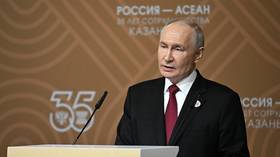
Reviewing the recent deal for a significant discount in gas price for Ukraine, Russian PM Putin said that this is a unique case and jokingly warned other partners against asking Russia for the same concessions.
At the government’s meeting on Thursday, Putin explained how it was possible to grant such a big discount to Ukraine. He said that neither Russian company Gazprom nor its shareholders are going to suffer losses as a result of the deal. The discount will be made at the expense of the country’s budget by abolishing export customs duties.
The PM pointed out that the money Ukraine will save as a result of the agreement will be accumulated in the country and will be seen as Russia’s payment for the presence of its Black Sea Fleet in Sevastopol from 2017 and beyond.
Putin stresses that the recent deals on the fleet and gas prices are valuable as they are evidence of the “trust” and “supporting of elbows” between Moscow and Ukraine.
Evgeny Volk, political analyst, thinks that the gas deal is extremely important for Ukraine.
“A top priority for Mr Yanukovich is to improve poor economic performance of his nation. The deep crisis from which Ukraine suffers greatly certainly is very difficult to overcome without Russian assistance, without cheap energy resources,” Evgeny Volk told RT.
Volk calls the recent agreements reached by Medvedev and Yanukovich a compromise, reflecting common ground and differences existing between the countries.
“In this case, I believe, Russia is a winner in a political sense,” says the expert. “Certainly to have military bases in Sevastopol, in Crimea, is a very significant victory for Russia because it prevents Ukraine from joining NATO in short and mid-term prospect,” says Volk.
However, according to Volk, from the economic point of view Russia will have to pay a high price in making significant concessions to Ukraine on gas issue.

22.04.2010, 16:11
1 comment
Kyrgyz interim government sets referendum and parliamentary election datesOn June 27 this year Kyrgyzstan will hold a referendum on changes to the constitution. Later, on October 10, parliamentary elections will also take place. |
UK witnesses televised battle of PM candidatesIn the UK, the three main candidates battling to become the next Prime minister take part in a U.S.-political style televised debate. |
Ukraine will have to follow the example of Finland as a neutral nation with links to both sides of Europe. That means a permanent Treaty which cannot be abolished by a next "orange" Nationalist Government trying to promote comfrontation between Russia and Ukraine, and between Russia and NATO. Sakashivili now is alone and should learn how things work. On the economic side, the Ukrainian Government knows that their products are not competitive in Western Europe and their whole industry would be wiped out if they join the European Union, but being the E.U. the largest Common Market in the World they will have to give something in exchange for a better access the same way as Turkey....And, again, Ukraine has much to gain if Ukraine joins Kazakhstan, Russia and Belarus to get a better deal with the European Union. Alone Ukraine would have got peanuts, nothing, a very bad deal with the E.U. saying "yes" to anything the E.U. Commission demanded from Ukraine. But if negotiations include Russia, Kazakhstan and Belarus, they can get a better deal as the combined population of the area (Russia, Ukraine, Kazakhstan and Belarus) is 215 million people. And, last but not least, common Aircraft projects like Antonov which included Ukraine, only can survive if the Ukrainian company integrates in the U.A.C. (United Aircraft Corporation). And even that way it will be difficult to survive in the present competitive international market so new deals will have to be reached with companies like Finmecannica (Italy), Embraer (Brazil) or Bombardier (Canada), and even deals with EADS and Boeing for technological cooperation.


For analysts familiar with the people who have accompanied Yanukovych into the corridors of power, however, there is an unmistakeable feeling of deja vous harking back to the days of former Urkainian President Leonid Kuchma when those around him benefited the most from a very non-transparent gas trade and other business activities. “We could be seeing a throwback to the Kuchma era where the current government seeks to cut deals with all neighbors in an effort to keep everyone happy while its members continue to enrich themselves at the expense of the nation’s welfare”, said Soukup. Russians have reason to look to the Georgian police for inspiration and as a blueprint for comprehensive reform. According to Kommersant, only 22% of Russians trust their police, a force which is considered by the public as corrupt and inefficient. In his recent article published on April 4, Stephen Sestanovich, an influential Russia expert at the Council on Foreign Relations wrote on the merits of Georgia’s police transformation and advised Russian President Dmitry Medvedev to follow suit. “Only one political leader in any post-Soviet state has ever attempted this kind of institutional upheaval, and the comparison is an ironic one for Medvedev. For that leader is … Mikheil Saakashvili of Georgia, who soon after becoming president in 2004 fired more than 80% of the country’s police officers…But however awkward the parallel may be, there are lessons in it for Medvedev. Saakashvili’s reform succeeded precisely because it was so radical.” Let’s imagine that Georgia had had a Putin-appointed minister of internal affairs. Not only would that have meant the lack of even basic internal sovereignty, but would also have ruled out the possibility of any reform. That is how sovereignty and modernization are intertwined in Georgian reality and that is why Putin so vigorously opposes both.