Remembering Russia's “shock doctor” Yegor Gaidar
Published 16 Dec, 2009 12:40 | Updated 21 Dec, 2009 11:31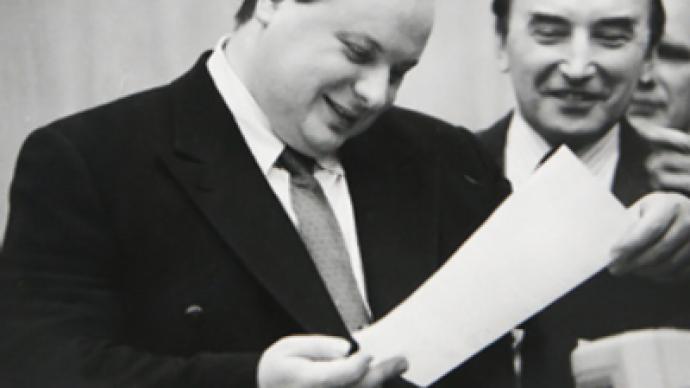
Gaidar, the young economic reformer under Boris Yeltsin, was responsible for helping Russia make the painful transition from a planned economy to capitalism.
The titanic implosion of the communist system offered western economists a rare opportunity to watch a planned economy adapt to capitalism and the free market. They really had no idea what to expect from the transition; there were simply too many variables at play in post-Soviet Russia to risk any safe predictions.
At the time, Boris Yeltsin was the president of Russia, a nation that was teetering on the edge of collapse. Unlike his predecessor, Mikhail Gorbachev, who was accused of initiating “half reforms” that left Russian store shelves bare, Yeltsin wanted a rapid transition. He turned to Yegor Gaidar as the man to do it.
“For Gaidar it was a shock,” commented economist Daniel Yergin in 'The Commanding Heights.' “There was no money in the treasury; there was no gold; there was not even enough grain to get through the winter. It was unclear who was even in charge of the nuclear weapons.”
“It was clear to me that the country was not functioning,” Gaidar commented. “The economy was not working, and that if nothing were done and if everyone feared that nothing would be done, it would end in catastrophe, even a famine.”
The smart young reformer – who served as Acting Prime Minister from June 15, 1992 until December 14, 1992 – described the experience of taking control of the Russian economy as “flying in an airplane and going into the cockpit and finding no one at the controls.”
Indeed, at the tender age of 35, Gaidar found himself in charge of steering Russia’s battered economy, bankrupt and corrupt after 70 years of mismanagement. He quickly assembled a team of youthful free-market reformers, among them 36-year-old Anatoly Chubais.
Communist hard-liners, seething from the sidelines, dubbed them the "little boys in pink shorts.”
Gaidar advocated liberal economic reforms according to the largely untested principle of “shock therapy,” which had every risk of killing, as opposed to rehabilitating, the ailing patient.
His most well-known decision was to abolish price controls regulated by the state as opposed to the “invisible hand” of the market. The immediate result was hyper-inflation across the board.
“Inflation came 500 percent, 600 percent, 700 percent,” Grigory Yavlinsky recalled in The Commanding Heights. “The monies simply went to the ashes, simply to nothing. The population was simply smashed by that hyperinflation, and that undermined all kind of belief in the economic changes.”
Mikhail Gorbachev, who opposed Gaidar’s reforms, said in comments carried by the Itar-TASS news agency that he “personally grieves” Gaidar's death. But he also made reference to what he called the shortcomings of his policies.
“Gaidar went into politics with many hopes but his plan was to (resolve all the problems) in one shot,” Gorbachev said.
In a daring move, and with the Communists breathing down their backs in Parliament, the reformers set out to democratize state industries by simply giving them away. In charge of this privatization program was Anatoly Chubais, who advocated giving Russian citizens vouchers that they could use to buy shares in privatized companies.
“We need millions of property owners, not just a few millionaires,” then Russian President Boris Yeltsin said. “All Russian citizens, workers, pensioners, and small children will be given privatization vouchers worth 10,000 rubles.”
Gaidar and Chubais knew if they didn't launch privatization by December 9, 1992, when the Congress of People's Deputies was getting together, the Communists would kill the program. They called on western banker, Boris Jordan, to help finance the vast project and find a business to privatize.
The Bolshevik Biscuit Factory, on the outskirts of Moscow, was selected to serve as a litmus test for privatization.
“We gave managers of their factories and the employees of the factories about 50 percent of the stock in the company,” Jordan recalled. “The balance of the equity would be sold in the public markets through these vouchers. We opened up the first official auction of a Russian company to the public on December 8, 1992.”
Although Gaidar ultimately lost his position as prime minister to Viktor Chernomyrdin, state companies were being bought, and a boisterous trade in vouchers gave birth to a fledgling stock exchange. Things were looking, if not up, then at least not spiralling out of control.
But observers criticize the tactics employed by Gaidar and his reform team as overly ambitious, even reckless. Yet Gaidar's reform succeeded in doing what it was supposed to do: give the first impetus to a free market economy.
“Gaidar was under remarkable political attack from the first moment,” commented Jeffrey Sachs, Harvard professor. “It wasn't seven days after the start of reform that the head of the Parliament called for the resignation of the government.”
One unfortunate by-product of Geidar’s reform initiatives surfaced in the late 1990s when a wave of brutal violence, reminiscent of America’s 1920 gangster era, swept the country. Cold-blooded contract assassinations of business owners and bankers in broad daylight became regular news.
It took years before the painful era of privatization, deregulation and liberalization gave way to a normally functioning market economy.
In 2006, Gaidar fell ill under mysterious circumstances at a book launch in the Irish capital Dublin. He speculated at the time that he might have been poisoned by individuals who hoped to smear Russia’s image, although doctors found no evidence.
Gaidar, 53, graduated with honors from the Moscow State University, Department of Economic, in 1978. He admitted to being strongly influenced by the economic writings of Milton Friedman and Frederick von Hayek, both affiliated with the University of Chicago. Thus, Gaidar and Chubais have been dubbed the “Chicago boys.”
America’s popular “Chicago School” of economics is associated with a particular brand of economics that advocates “free market” support of limited taxation and private sector regulation, but differs from laissez-faire free-market principles in its support of government-regulated monetary policy.
Russian President Dmitry Medvedev has sent condolences to Yegor Gaidar's family and friends, the Kremlin press service reported on Wednesday.
"An outstanding economist and a statesman, whose name is associated with resolute steps on forming foundations of free market and our country's transition to a radically new path of development, has passed away," Medvedev said in a letter.
Gaidar was a brave, honest, and determined man, who "assumed responsibility for unpopular but essential measures in a period of radical change," the president said.