One small step for Russia, one giant leap for Eurasian Union
Published 18 Nov, 2011 13:40 | Updated 18 Nov, 2011 17:57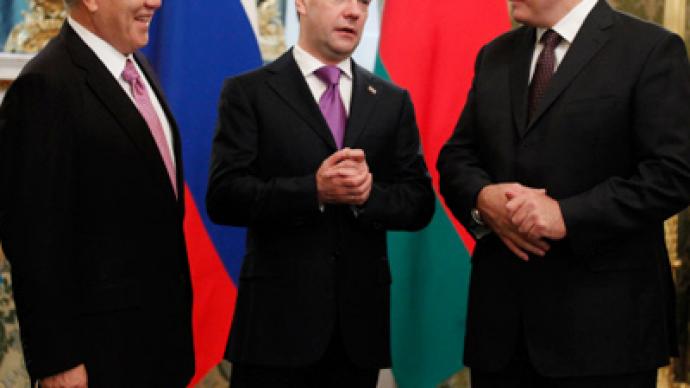
As the ink dries on new economic integration documents signed between the Russian, Belarusian and Kazakh leaders on Friday, observers analyze what role the Eurasian Union will play on the global stage.
The declaration paves the way for the next stage in the integration process – the Common Economic Space (CES), based on the rules and principles of the World Trade Organization (WTO). The union will be open to new members at any stage of its formation.With the signing of the 'Declaration on Eurasian Economic Integration' and the 'Agreement on the Eurasian Economic Committee (EEC),' Russia is prepared to move towards greater integration with Belarus and Kazakhstan before pre-planned 2015, but will not be "forcing the process," President Dmitry Medvedev told a news conference following his meeting with Presidents Aleksandr Lukashenko and Nursultan Nazarbayev."Should there be preconditions, we shall move faster," he said. "We are not running ahead of a train…but should there be an opportunity, we will expedite the process.”Meanwhile, Medvedev said he does not fear that the Eurasian Union will face problems similar to those being faced by the European Union, which is presently threatened by potential collapse due to a sovereign debt crisis."I do not have any fears whatsoever," he said. "We should work accurately and will mind experience of the European Union." Medvedev, using colorful language, said that that during the formation of the European Union, Brussels “bought a pig in a poke.” Russia has learnt from those mistakes, and is gradually organizing the union with countries that have strong similarities."We know who is joining us in the integration,” he said. “They are three countries that share common history, common past, and today we are forming a common economy.“We are not starting the integration process from different levels, but rather from similar grounds,” he explained.The Russian leader then mentioned the integration process for other potential member states of the Eurasian Union."We are open, but this does not mean that any country may join us tomorrow," he said. "Each country should have a clear picture of joining, while following certain requirements to prevent any negative effects on the Union, as well as the economy of a candidate-country.”Speaking on the potential advantages of the Eurasian Union, Kirill Koktysh, associate professor of International Politics at Moscow State University, said the Eurasian Union will serve as a “bridge” between the European Union and Asia.“The creation of a Eurasian Union will provide a boost to the European Union, which will have an overland bridge to China and other rising Asian markets,” Koktysh told RT.This will also have the effect of providing cheaper goods from China, he added, which is especially important at this crucial juncture in the history of globalization as the EU faces “profound, existential challenges.”Meanwhile, Boris Makarenko, chairman of the board of the Center of Political Technologies said that talking about the future challenges of the Eurasian Union is not unlike attempting to predict the chances that a newborn baby will get some sickness associated with old age, like arthritis. In an interview with RT, Makarenko said that when the European Union was in the first stages of creation no one knew about the possibility of today’s problems. The signing of the document today, therefore, is an important step, but it is only the beginning. Makarenko then pointed out some of the differences between the EU and the Eurasian Union.“The structure of the (Eurasian Union) is very different from the EU as Russia is an absolute leader, while in the EU even Germany is strong but not completely overshadowing other members,” he said. “So it will be easier to overcome problems through Russia’s leading role.”Speaking on the potential to create some sort of future “super-union between the European Union and the Eurasian Union,” Makarenko said such an idea would “require decades.”First all member-states of the new union must join the WTO, then they must bring their technical regulations in line with the EU and only then could such a “super-union” be negotiated. But it is possible in principle, he added.Meanwhile, the chairman of the board of the Center on Political Technologies said he hoped that the negative response given by some observers in the west would soon “die out.” “I am speaking about the comments that suggest that somehow the Eurasian Union is the resurrection of the Soviet Union,” Makarenko said. “When the West sees that this is not the case they will see the tremendous possibilities of cooperation.”Indeed, nothing could spoil the upbeat mood in the Kremlin, the site of the signing ceremony.Medvedev has said that the Eurasian Economic Union, the founding documents of which were signed by Russian, Belarusian and Kazakh leaders on Friday, will shape the subsequent development of these three countries."We have come a long way to this very important event,” the Russian leader told a press conference after the signing ceremony. “Our meeting today has the chance to become one of the key events of the current year.“We have made another very powerful step down the path of forming the Eurasian Economic Union (EEU) – an organization that will no doubt shape the future of our countries,” Medvedev added.The Russian leader paid special thanks to Kazakh President Nursultan Nazarbayev, who "was the author of this idea in the very difficult 1990s when even the word 'integration' was perceived as a relic of the Soviet-era lexicon."Medvedev also expressed his gratitude to Belarusian President Aleksandr Lukashenko for proposing the idea to hold an official signing of the Declaration on the Eurasian Economic Integration, the Agreement on the Eurasian Economic Commission (EEC) and the EEC regulations.Robert Bridge, RT