Reset redux: Washington’s ‘secret letter’ to Moscow provokes speculation
Published 13 Feb, 2013 11:59 | Updated 13 Feb, 2013 16:09
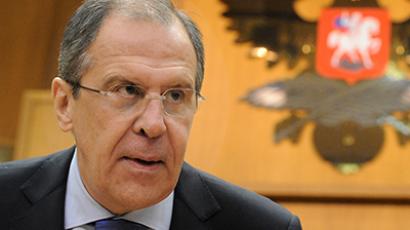
Alexei Pushkov, the head of the State Duma committee on international affairs, believes that a top Washington aide will deliver to Moscow offers on nuclear disarmament in an upcoming visit.
"The US president's National Security Advisor Thomas Donilon is expected to arrive in Moscow in February,” Pushkov told a news conference in Moscow on Wednesday. “He is expected to bring a so-called secret letter."
The leading Russian politician, while admitting that “no one knows what this letter will say,” said he believes it will contain “some proposals in the sphere of disarmament, including nuclear."
US President Barack Obama’s 'Global Zero' campaign, which proponents praise as visionary and critics ridicule as wishful thinking, largely hinges on what Russia, also a nuclear superpower, thinks about the plan.
Pushkov slammed Obama’s efforts to eliminate nuclear weapons as “pure propaganda and a romantic idea," reminiscent of Khrushchev's suggestion of “universal and complete disarmament in 1961.”
The high-ranking politician from the United Russia party argued that for some countries, like Israel, nuclear weapons are non-negotiable: “There is one country to which nuclear armaments are absolutely critical; this is Israel. Israel will never discard the nuclear deterrence potential because it is surrounded by the potentially hostile Arab world.”
President Obama’s Global Zero campaign ends in Israel before it even starts, Pushkov said, adding that other countries have made “colossal investments” in nuclear arms, and will simply not abandon them.
This results in a large footnote being attached to Obama’s campaign for eliminating nuclear weapons from the military equation: Washington’s decision to build a missile defense system in Eastern Europe, just miles from the Russian border.
Despite earlier pledges to cooperate with Russia on the system, US and NATO officials now seem prepared to alienate Moscow over the project, risking nothing less than “another arms race” as Russia will have no alternative but to strengthen its deterrent capabilities, Pushkov said.
Moscow's concerns come down to basic military strategy: As long as the US and NATO continue to pursue missile defense without Russia’s cooperation, efforts to bilaterally reduce nuclear weapons will falter.
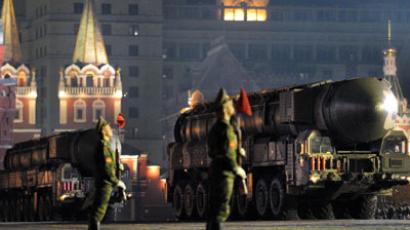
Indeed, Moscow has made it clear that it reserves the right to quit the New START agreement – an arms control treaty signed between Russia and the US and ratified on April 8, 2010, limiting the number of deployed strategic nuclear warheads on both sides to 1,550 – if it is decided that the missile defense system poses a threat to the strategic balance.
“The US missile defense system – is surely one of the key issues on today’s agenda because it involves Russia’s vital interests,” President Vladimir Putin said in an interview with RT. “But naturally, as our American partners proceed with developing their own missile defense we shall have to think of how we can defend ourselves and preserve the strategic balance.”The Obama administration's multibillion dollar missile defense system, ostensibly designed to protect Europe and the US from a ‘rogue’ missile attack, was criticized in an unclassified report by the Government Accountability Office (GAO) as “potentially unfeasible,” the Associated Press reported last week.US military officials declined requests to discuss the study on the record, noting the material was classified, according to AP.Another factor that may cause Washington to reconsider its missile defense plans is Iran, which Washington has argued is the main reason it is building its missile defense system in Europe. The US and Israel, among other countries, believe that Tehran is secretly developing a nuclear weapons program.Iran has denied the claims, and maintained that its nuclear program is aimed at providing a new source of energy for its civilian sector."The United States has changed its tone regarding Iran," Pushkov said. "Whereas before many discussed a military scenario, at the Munich Security Conference US President Joseph Biden placed emphasis on a diplomatic solution."At the Munich conference in early February, Biden underlined that Iran, which has been hit hard by a stiff international sanctions regime, need not “sentence their people to economic deprivation and international isolation.” "There is still time, there is still space for diplomacy backed by pressure to succeed,” Biden said. “The ball is in the government of Iran's court."Pushkov recalled that Biden mentioned what he described as "a window of opportunities," but at the same time warned that these opportunities were not infinite. The Russian MP emphasized that while Russia is against a nuclear-armed Iran, it is equally opposed to any “military scenario” to resolve the matter."Russia is not interested in a nuclear Iran, because then other countries in the region will be interested in having nuclear arms, too,” he warned. "But we reject the military scenario, because it would be a great evil."Discussing the so-called Russia-US reset, which Pushkov said “has exhausted itself,” he noted that the relationship has “entered a phase of reformatting.” While acknowledging the achievements between Washington and Moscow – including partnership in Afghanistan, Russia's accession to the WTO and the signing of a nuclear arms reduction treaty – Pushkov held out hope that the Russia-US relationship would get back on track in 2013.Saying that he did not personally regret the resignation of former US Secretary of State Hillary Clinton, Pushkov expressed hopes that Clinton’s replacement, John Kerry, will not be an “ideologically-driven politician.”"If Chuck Hagel is approved as Pentagon chief, he is also known as [a] political realist," Pushkov said, adding that a Kerry-Hagel tandem could have a positive effect on Russia-US relations. "In any case the 'reset' has fulfilled its tasks, but failed to resolve, in particular, such area of disagreement as missile defense.”Robert Bridge, RT