Saakashvili opens propaganda monument to “freedom fighters”
Published 27 May, 2010 10:14 | Updated 10 Jul, 2010 20:50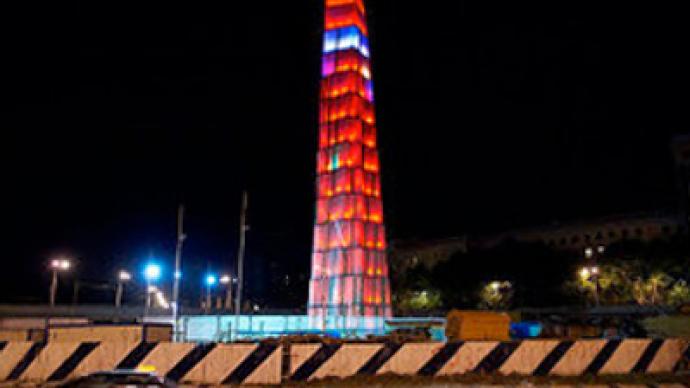
On Wednesday, Georgian President Mikhail Saakashvili unveiled the country’s tallest monument. The “Tower of Heroes” is in honor of the soldiers who died for independence – but only to the ones who fought against Russia.
The 48-meter-high structure of metal and plastic has golden engravings of almost 3,500 names. Many plaques are left blank, and new names will probably be added in the future. In a solemn speech, Saakashvili, the mastermind behind the tower’s concept, said he is prepared to have his name on the monument, and every true Georgian should be too.
Numerous critics of the Georgian president were quick to point out the Freudian overtones in the construction of the structure. It is even a few meters higher than the monument to victims of World War II in Kutaisi, which had been demolished on Saakashvili’s order in December to make way for a new parliament building, officials said.
The choice of the names engraved on the tower leaves little doubt about the propaganda nature of the new monument. The history of the Georgian state dates back many centuries, and the peak of its power in the region was between late 12th and early 13th century. But not a single name of Georgian heroes, who conquered new lands under legendary Queen Tamar or repelled invading Mongols, Ottoman Turks and Persians in the following centuries made their way on to the Tbilisi tower.
Apparently for Saakashvili, the timeline of heroism starts in 1918, with the short-lived independent Georgian Republic formed in the wake of the Russian Bolshevik revolution and the civil war. The “true heroes” praised by Tbilisi are the Georgian cadets fighting against the Red Army and members of the anti-Soviet uprising in 1924.
But also there are soldiers who participated in the disastrous attack on secessionist South Ossetia in 2008 and the 13-month-long war in Abkhazia in the early 1990s. Why would people killed while trying to squash rebellion in breakaway regions and put them under Tbilisi control be called “fighters for Georgian independence”, is a mystery. That is, unless, propaganda goals are more important than historical accuracy.
For the current Georgian government Russia is the supervillain, and, according to comic book logic, anyone fighting a supervillain is a hero. The effort to distance from the neighbour sometimes looks bizarre, for instance, when the Georgian Foreign Ministry asks other nations to call its country the Western-style “Georgia”, and not Russian-style “Gruziya”. Georgians themselves call their country “Sakartvelo,” while both variants of the name used in foreign languages have Persian roots and was adapted differently in different countries.
Ironically, back in the second half of the 18th century, the Russian Empire was viewed by the kingdoms, which used to be parts of a united Georgia, as an ally against Ottomans and Persians. Both powers had a record of invading and occupying the lands, taking captives as slaves and pillaging settlements. At the same time, Russia was a Christian nation with culture similar to that in Georgia, and it needed allies and footholds in the region for the future war with Turkey.
Certainly, the transition of Georgia under Russia’s control was far from being smooth. Georgians had reasons to complain about Russia’s insufficient military support, promised to them by the Treaty of Georgievsk – which made eastern Georgia a protectorate – while the Bagrationi royal family was eventually dethroned despite previous agreements. On the other hand, both Georgian nobility and clergy were given a rightful place in the Russian Empire and not oppressed. Anyway, it was Russia which managed to re-unite the former kingdom.
By depicting modern Russia as a sinister and greedy would-be empire, which had been conspiring to expand and rob its provinces – Georgia included – for all its history, Saakashvili goes against truth. Saying that Georgians and Russians had no conflicts in their history would be ridiculous, but the same can be said about any two neighbour countries. Saying that they had no good things between them is just as wrong. Conflict rhetoric may win political points today, but at the same it poisons the future, making reconciliation harder to achieve.