VERSIONS: روسيا اليوم NOTICIAS FREEVIDEO ИНОТВ RTД
breakingnews
Go to main page   Politics   Remembering Stalin’s Great Purge victims  
MORE ON THE STORY
RIA Novosti / Sergey Pyatakov, STF 21.12.2009, 14:42 9 comments

The public discussion about Stalin shows how free we are - observer

Dmitry Babich from Russia Profile magazine believes that Russia now has real freedom, including the freedom to say whatever people really think about Stalin.

01.05.2010, 11:00 1 comment

Russia joins workers across the globe to mark Labor Day

Thousands of Russians from the country’s labor unions and political parties have taken to the streets to celebrate Labor Day, also known in Russia as Spring Day.

18.02.2010, 21:46 17 comments

Cult of Stalin continues to divide and conquer

Moscow City Hall has approved hanging posters of Stalin throughout the city in the run up to Victory Day, but tempers are running high.

Joseph Stalin, image from poster.ru 21.12.2009, 19:24 14 comments

Stalin: feared and revered

Today marks 130 years since the birth of Joseph Stalin, one of the most controversial figures of the 20th Century.

Joseph Stalin 05.03.2010, 14:46 19 comments

Stalin will return to Moscow streets on Victory Day

A war of words over the name of Joseph Stalin, who died 57 years ago, is being fought in Moscow, the city where he is buried. The country he led to victory in World War II is still divided over Stalin's place in history.

Vladimir Kremlev for RT 23.02.2010, 11:00 2 comments

ROAR: “Billboards will not improve Stalin’s role in history”

The idea of the Moscow authorities placing stands with information about Joseph Stalin during World War II has immediately found its supporters and opponents.

A copy of a portrait of Joseph Stalin 01.09.2010, 10:40 19 comments

“Stalin largely determined USSR victory in WWII” – Russian State Archive boss

There is only one history, but there are quite a few interpretations. The 20th century saw quite a number of serious attempts to rewrite history, says the head of the Russian State Archive Sergey Mironenko.

Beloved Stalin is the People's Happiness - Soviet poster(image from www.davno.ru) 03.09.2009, 10:44 12 comments

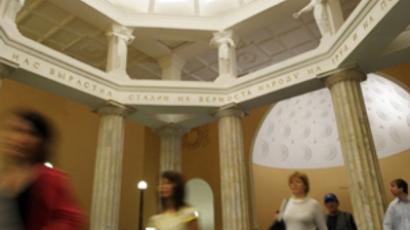
Furore over Stalin’s return to Moscow metro

The restoration of a Moscow metro station has revived debate over how Russians view the Soviet leader Joseph Stalin. The station features an inscription from the 1950s, praising the man.

Vladimir Kremlev for RT 02.11.2009, 15:10 9 comments

ROAR: “Stalin no longer effective manager”

The Russian president is using his authority to transform society’s views about the repressions of the Stalin era, observers say.

Soviet-era slogan reading, "Stalin raised us to be loyal to the nation, inspired us to labour and great deeds," inside a freshly-refurbished metro station in Moscow (AFP Photo / Dmitry Kostyukov) 08.09.2009, 14:12 4 comments

No place for Stalin in Moscow Metro – activists

Human rights activists have sent an open letter to the mayor of Moscow demanding that a line from a Soviet anthem praising Stalin be removed from a newly-restored metro station in the Russian capital.

Remembering Stalin’s Great Purge victims

Published: 30 October, 2009, 23:36
Edited: 27 May, 2010, 11:12

(4.3Mb) embed video

TAGS: Anniversary, Russia, Human rights, Stalin


On Friday, Russia marks the Day of Remembrance of the Victims of Political Repressions. Millions suffered from Stalin’s repressions from the 1920s through to the 1950s.

Memorial services have been held across the country.

Ahead of the day, President Medvedev said attempts to justify the Stalinist repressions under the pretext of state interest are unacceptable:

“I am convinced that no development of a country, no success or ambitions of the state, should be achieved through human grief and loss. Nothing can be valued above human life, and there is no excuse for repression.”

Meanwhile on Thursday, Russia’s civil rights group “Memorial” organized a rally in central Moscow to remember those executed in the Russian capital between 1937 and 1938. A large crowd gathered throughout the day in the heart of Moscow, lighting candles and reading out a roll-call of names of more than 30,000 people who perished at that time.

Every person who was in attendance has a personal reason to be there.

“My father was a doctor, he was arrested in 1934. For decades they told us he was alive in a prison camp, and then in Khrushchev times he was rehabilitated. We discovered he had been executed – shot dead in 1938,” a participant of the rally told RT.

Mass graves for more than 20,000 bodies were discovered just outside Moscow at the Butovo polygon. A few years ago, a church was founded there in remembrance of the politically repressed. Father Kirill heads the clergy, and says it was his calling, as his grandfather was shot there – a Christian who, like many others, refused to renounce his beliefs.

“The Soviet Union punished religion with executions. This place is unique – 300 priests killed here were later canonized. Not only Christians were shot, but also Muslims and Jews. All religions were equal in the face of death in Stalin times,” Father Kirill said.

In the 1990s, Russian security services opened some of the Soviet secret files. It was discovered that not only were the intelligentsia– i.e. scientists, teachers, high-ranking officials and other figures who had allegedly questioned Stalin’s power – killed, but also many ordinary people. Hundreds of thousands more were sent to die in gulag prison camps.

Fact box

From the 1920s through to the 1950s in the Soviet Union

52 million political sentences were passed
6 million people were deported without sentence
1 million people were executed

(From “The History of Stalin’s Gulag”, a collection of documents in seven volumes, 2005)

“KGB archives state that about 4.5 million people were repressed in the Soviet era, while more than 800,000 were executed. Only 3,000 death penalties were handed out after the Stalin era. Once his cult of personality was destroyed, more than 75% were rehabilitated posthumously,” said Dr Viktor Zemskov, a historian from the Russian Academy of Sciences.

Watch video to find out more

downloadembed

The Day of Remembrance of the Victims of Political Repressions has been commemorated in Russia since 1991. The civil rights group “Memorial” leads the drive to remember.

“Russia should build a civil society. Every one of us should stop focusing solely on our individual benefits. Only then can we prevent further tragedies like the Great Purge,” believes Anna Karetnikova from Memorial.

Late into the evening, people continued coming to Moscow’s Lubyanka Square despite the bad weather, reading name after name of those who were victims of Stalin's Great Purge, making sure it is never forgotten and that history does not repeat itself.

Read also Secrets of Stalin's Seven Moscow Skyscrapers

+2 (81 votes)
 
Back to top
next MORE NEWS
30.10.2009, 18:51

Russia’s getting back to death penalty is “purely theoretical” – Ombudsman

Russia’s Constitutional Court has accepted the request of the country’s Supreme Court to consider the issue of capital punishment on November 9.

An Iranian technician works at the control room of the Isfahan Uranium Conversion Facilities (AFP Photo / Behrouz Mehri) 31.10.2009, 18:37 4 comments

Iran rejects UN plan in sake of national pride

Iranians are proud of their nuclear program and won’t give it up, says Vladimir Sotnikov from the Institute of World Economy and International Relations, but it was their chance to prove their peaceful intentions.

Kihnu December 22, 2009, 16:05
+1

I was on assignment to Estonia during the 1990s, and have been visiting the country quite often ever since. Last year my business took me five times to Estonia. I will try to give you my impression on this Nazi matter as clearly as I can below: #1. I never witnessed any Estonian admiration for the Nazis either in the public media or in my private conversations with Estonians. #2. Some mischievous people are simply using this Nazi babble to blunt any Estonian effort to integrate the Russian minority. #3. These same people are the ones who criticize Estonia for showing respect for the soldiers who fought with the German army to keep the Red Army from invading their homeland. This respect was denied these veterans, and those who dies, during the Soviet era. #4. Some of Estonia's Russians have been deviously brainwashed to scream "Nazis" whenever they have a problem. Somewhat akin to American blacks screaming "racists" whenever they can't get their way.

Marzipan6 November 09, 2009, 10:24
0

To Scorpio, Part 1: Scorpo’s breathless “BREAKING NEWS” is over 5 years old. If there are Nazi parades in Estonia around every corner, which is the impression one gets from Russian accusations, why doesn’t he bring two or three events to our attention from last week or last month, complete with pictures? There is no shortage of pictures of troops and veterans in Stalin-era uniforms, wearing Stalin-era medals, goose-stepping under Stalin-era red flags before the President of Russia, who takes their salute. Where is the Estonian Nazi-oriented equivalent? No one can find it, not even Scorpio. And yet he, and Russia, accuse Estonia of glorifying Nazism. Estonia does not accuse Russia of glorifying Stalinism each year. I will comment on each of the two articles Scorpio refers to. Because of limitations of space imposed by RT, I will need to divide my post into three parts.

Marzipan6 November 09, 2009, 10:23
0

To Scorpio, Part 2: Scoprio’s 5 year-old article, “Outrage as SS Men Hold Anniversary Celebration in Estonia” begins, “The EU newcomer Estonia was accused of amorality and gross historical insensitivity yesterday as it allowed veterans of the Nazi Waffen-SS to parade through its capital Tallinn.” The accuser was Yevgeny Satanovsky, President of the Russian Jewish Congress. If that one parade was a celebration of Nazism, then the yearly May parade in Moscow is a celebration of Stalinism. Parading Russians either fought in, or remember those who fought in, Stalin’s Red Army. Yet they are not there to celebrate Stalinism; they are there to honor those who fought bravely against a horrific invader of Russia. The same in Estonia. The sacrifice of people who fought against a horrific invader of Estonia were honored. In this case, the invader was Soviet Russia. That they fought in German uniform was because Russia itself, in its first occupation 4 years earlier, in the midst of its murder and enslavement of thousands of Estonian civilians also found time to dismantle the Estonian army. From then on, Estonians were unable to fight in their own military. As for the Waffen-SS, Estonians were faced with either greeting their Soviet tormentors and killers with flowers, or fighting them within units that existing German occupiers assigned them. Yet even so, the Waffen-SS, which were front-line troops, needs to be distinguished from the regular SS, which were Hitler’s internal security thugs. Here’s part of what the on-line Jewish Virtual Library says: “Towards the end of 1943, it became apparent that numbers of volunteer recruits were inadequate to meet the needs of the German military, so conscription was introduced. The Estonian 20.Waffen-Grenadier-Division der SS (estnische Nr.1) is an example of such a conscript formation, which proved to be outstanding soldiers with an unblemished record.” I wonder has Yevgeny Satanovsky read that?