50 years of sanctions: time for a Cuban healing
Published 20 Oct, 2010 13:58 | Updated 22 Oct, 2010 05:09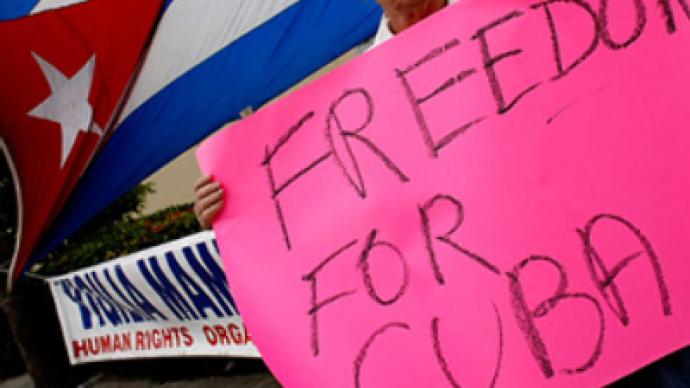
Despite 50 years of US blockade, Cuba has somehow survived as one of the few remaining communist states. So is it worth keeping? RT looks at the pros and cons of the sanctions.
In 1492, as Christopher Columbus sailed the ocean blue, he stumbled upon an island which possessed beauty the likes of which he had never previously seen. Through the years the Island of Cuba developed into one of the most prosperous Latin American nations with riches in coffee, lush sugar plantations and its legendary tobacco. For the Past 50 years, however, the small Caribbean nation has been engaged in an epic ideological battle with its superpower neighbor to the North – the United States of America.
In an effort to rid the world of the evils of communism and as a reactionary measure to the nationalization of private property in Cuba, America has enacted one of the longest economic and travel blockades against a specific nation in modern history. Now as the 50-year milestone has arrived, the global community is almost united in the belief that the sanctions against Cuba have failed. Taking it a step further, the world is wondering why the American policies are continuing to this day.
To fully understand the conflict between Cuba and the United States, one must go back well beyond the most recent 50-year standoff and all the way back to the Spanish-American War. At the Treaty of Paris in 1898, Cuba actually became a territory of the United States, along with Guam, the Philippines and Puerto Rico. Not much later, in 1902, US President Theodore Roosevelt allowed Cuba to claim its independence as a free nation, but in an agreement with the new government, he secured two major advantages—America’s right to oversee Cuba’s international and financial affairs, and the lease of a naval base at Guantanamo Bay.
Through the course of the next six decades, Cuba and America enjoyed brilliant relations. The thriving Cuban economy played host to a variety of American tourists and businessmen, and the island was considered one of the gems of the Caribbean. By 1958, the US was comfortable with the arrangement in Cuba, having supported the rise in power of President Fulgencio Batista and with American businesses having a significant stake in the country’s economy.
In 1959 everything changed.
Famed resistance movement leaders Fidel Castro and Che Guevara lead a group of rebels through a series of campaigns, culminating in the Cuban Revolution. With the American-backed Batista exiled to Portugal, one of the first moves of the new government was to seize all private assets in the country and nationalize utilities and public services. It is estimated that American interests in Cuba suffered a loss of more than US$1 billion in assets through this move. To complicate matters, the Cold War was already in full swing and the new regime was closely aligned with the Soviet Union. America’s biggest fear, the threat of communism, was now knocking on the door.
In 1960, President Eisenhower enacted the first serious embargo against Cuba, halting all sugar purchases from the country, ending all oil deliveries and continuing arms embargos that were in place during the revolutionary period, starting in 1958. This action also authorized the mobilization of Cuban exiles to try and overthrow Castro in an attempt to regain US control over the country. Sanctions against Cuba were initially set in motion to destabilize the Castro government.
As it became clear that the Soviet Union was building missile bases in Cuba, just 90 miles from the island of Key West in Florida, President Kennedy strengthened existing sanctions to include banning American companies from doing business with any country that in turn helped or aided Cuba. Kennedy also created a siege of the island, not allowing Soviet goods to reach Cuba. This event became known as the Cuban Missile Crisis, a showdown between Cold War rivals that brought the world to the brink of nuclear war.
From 1960 until today, there have been many different continuations, variations and alterations of the American embargos and sanctions against Cuba. Different American leaders have all tried various tactics, but to no avail. President Carter in 1977 even tried to relax the ban on US travel to Cuba, but was unsuccessful, as President Reagan reinstated the restrictions again in 1980.
The original intention of ousting the Castro regime from power has failed. Currently Raul Castro, one of the original revolutionaries and brother to the still-viable Fidel, is president of the survival nation.
While 50 years of sanctions have certainly not achieved the results that America would have liked, they have succeeded in keeping the people of Cuba from having adequate water, food and medical supplies. Thousands of refugees from Cuba have tried to seek asylum in America, but have been turned away and sent back by the US Coast Guard. Critics of the embargoes say the restrictions are actually helping strengthen the Castro power structure. Evidence of this is supported by the actions of other nations such as China, Russia and Venezuela, which have stepped up trade to fill the void created by American policy. It is also interesting to note that other former communist regimes failed despite America’s willingness to trade with them, including the Soviet Union. Cuba has instead maintained its political structure, perhaps even aided by the American isolation strategy.
Through the years the United Nations has passed, with majority support from the member nations, several motions to lift the embargoes. President Obama has publicly stated that he is interested in seeking a new start with Cuba, and along those lines has eased restrictions since his inauguration. Even Fidel Castro has backed away from his ideals and has welcomed the idea of an open dialogue with America. “The damage that it is causing is measured not only by the economic affect. It costs human lives and causes the suffering of our citizens,” Fidel Castro said.
With 50 years of failed American policy on the subject, Castro and Obama seemingly in agreement, and the global community pushing for a resolution, it seems that it is time to lift the restrictions and move forward in a new chapter in Cuban-American relations.
Sean Thomas, RT