Chechen militant Zakayev detained and released in Poland
Published 17 Sep, 2010 07:25 | Updated 26 Oct, 2010 19:46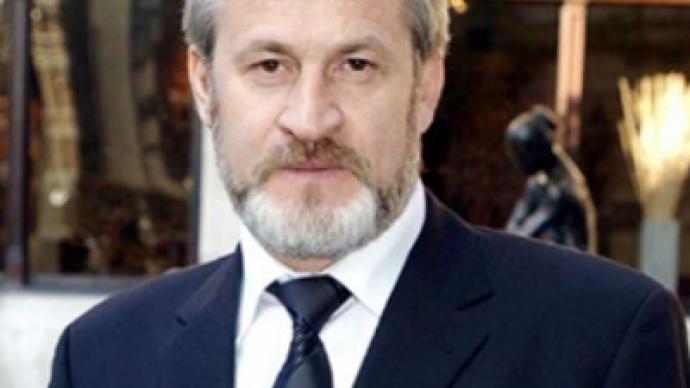
Chechen militant envoy Akhmed Zakayev has been released after the Warsaw district court declined the prosecutor's request to hold Zakayev in detention for 40 days.
The court ruling is not final and may be appealed. The Warsaw Prosecutor's Office will most likely consider this case on Monday, spokeswoman Monika Lewandowska said as cited by Itar-Tass. Meanwhile, Zakayev left Poland on Sunday, but, according to his representatives, may return to the country as soon as on Tuesday.
Zakayev arrived in Poland to take part in the so-called World Chechen Congress, which was held near Warsaw on September 16-18. The man is wanted in Russia on charges of taking part in terrorist formations. Interpol has declared Zakayev internationally wanted on Russia’s request.
Following the news of his detention in Poland, the Russian Prosecutor General’s Office filed an extradition request.
“Due to the detention of Akhmed Zakayev in Poland and in accordance with the European convention on extradition, the Russian Prosecutor General's Office is currently preparing material with a Polish translation, which will be sent to the Polish authorities for [Zakayev's] extradition to Russia,” the spokeswoman Marina Gridneva told Interfax agency on Friday.
In a telephone conversation with his Russian counterpart, Polish Prosecutor General Andrzej Szeremet assured that Warsaw would act in accordance with international law and Russian-Polish bilateral agreements rather than “under the influence of political factors,” reported Itar-Tass.
Russia’s Prosecutor General Yury Chaika told his Polish colleague that all the additional materials on Zakayev’s case were translated and submitted to Poland.“Chaika has guaranteed that if Zakayev is extradited to Russia, all his rights – provided for by international law – will be observed and the court will pronounce a fair judgment,” the body said.
Zakayev was delivered to Warsaw’s district prosecutor’s office in a police car, reported RIA Novosti. Addressing the journalists who were at the scene, he said “Poland is a free country, so I have nothing to hide.” He added that he voluntarily wanted to give testimony over Russia’s accusations and entered the building.
Earlier, his assistant Adam Borowski – calling himself “the honorary consul of the Republic of Ichkeria” in Poland – said Zakayev would appear at Warsaw prosecutor's office on Friday morning.
“Zakayev, accompanied by his lawyer, will present himself at the prosecutor's office at 08:00 (10:00 Moscow time),” he said, cited RIA Novosti. “Zakayev did not arrive to Poland for hiding, Poland is not Akhmed Zakayev's enemy,” Borowski added.
Talking to Polskie Radio (Polish Radio), “the consul” expressed hope that Poland would not get involved in a Russian prosecution.
“I do not believe Poland will deliver him into the hands of the Russians. But due to the thaw in Polish-Russian relations, nothing is certain,” he was quoted as saying.
However, Poland’s Prime Minister Donald Tusk said that the decision over Zakayev would be made “in accordance with Polish interests and principles of the rule of law and fairness.”
Talking earlier to a local radio station, Interfax cited, Tusk said that he believed the case was quite simple. “The Russian side insists on the Chechen leader’s arrest. Under the law, Poland has to take action. However, we are not going to fulfill Russia’s ‘orders’,” he stated. While the question of extradition is examined by court, the final decision is made by the Polish Minister of Justice, he added.
Earlier this week, Poland vowed to detain Zakayev if he appeared in Warsaw. It was expected that he might show up in the Polish capital to attend the World Chechen Congress, organized by the leadership of unrecognized Ichkeria.
Moscow stresses militant is internationally wanted
The Russian Foreign Ministry has emphasized that Zakayev, detained on Polish soil, is on the international wanted list.
“We have accentuated the fact that Zakayev is internationally wanted. A respective Russian application is registered with Interpol,” the ministry spokesman Andrey Nesterenko said at a media briefing on Friday.
Russia’s Upper House, the Federation Council, stressed that Poland should comply with Interpol’s recommendations and hand over the Chechen militant envoy to Russia.
“Poland needs to comply with Interpol's prescriptions, although it is clear that Zakayev has a large number of supporters and very serious work will have to be done. Zakayev's fate after his arrest is not so unequivocal,” First Deputy Speaker of the Federation Council Aleksandr Torshin told Interfax.
He reminded that not long ago the US designated one of Russia's most wanted men, Doku Umarov, as a terrorist, which is a sign of progress in international cooperation in countering terrorism.
“Interpol's decision on Zakayev is in the same row. Currently, we are cooperating with Poland very closely, including in the law enforcement area,” Torshin added.
According to the official, Poland is interested in extraditing Zakayev. “If such criminals are not extradited to the countries where they committed a crime, then what sort of international solidarity are we talking about?” he said.
No European country, he went on, is insured against terrorism. “If you do not want to have explosions in your country, you should extradite criminals,” Torshin stressed. One of the key values of a democratic state is compliance with the law, and in this particular case Poland has every reason to do so, he said.
Zakayev, the self-proclaimed Prime Minister of “Independent Chechnya-Ichkeria”, was granted asylum in Britain in 2003. In Russia he is accused of a number of grave crimes including terrorism, murder, robbery, banditry and hostage taking. Zakayev, 51, has also been put on the international wanted list for “crimes against life and health, crimes against life and health attempt, kidnapping, organized crime, terrorism,” Interpol’s official website states.
In the nineties, during the first Chechen campaign, he took active part in forming militant groups and led one of them, the so-called “South-Western front”. The Russian prosecution accused the gang of 11 criminal episodes, including an attempt to seize a railway station in the Chechen capital, Grozny. Over 300 policemen – who were guarding the building – were killed in the attack.
Zakayev worked as culture minister and deputy prime minister in the Chechen government in the late 1990s. He fled to Great Britain after Chechen militants were defeated. Russia issued an arrest warrant for the militant in 2001 and sought his extradition on charges of terrorism, but the UK has repeatedly refused the request.