Keep up with the news by installing RT’s extension for . Never miss a story with this clean and simple app that delivers the latest headlines to you.


Other side of Sandy: Caribbean devastation (PHOTOS)

Published time: October 31, 2012 12:00
Edited time: October 31, 2012 17:01
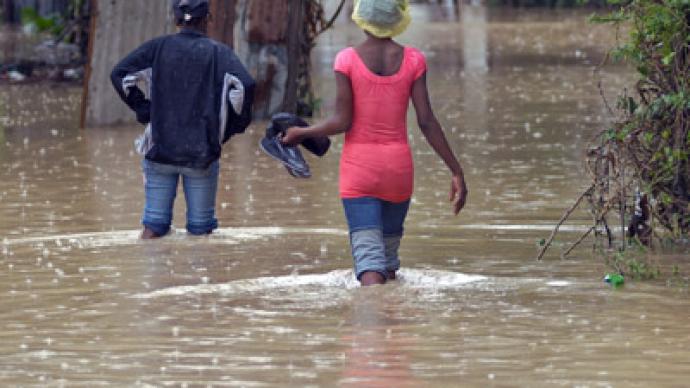
Haitians walk through a street flooded by rains from Hurricane Sandy in Port-au-Prince October 26, 2012. (Reuters/Swoan Parker)

Hurricane Sandy’s toll in the Caribbean amounts to at least 69 dead, thousands homeless and few funds available to rebuild. Yet, the Caribbean carnage remains largely behind the scenes as media spotlight focuses on the US.

Sandy took the lives of 52 people in Haiti, 11 in Cuba, two in the Bahamas, two in the Dominican Republic, one in Jamaica and one in Puerto Rico.

In light of the difficulty to rebuild in some of the impoverished areas of the Caribbean, especially Haiti, the United Nations will be appealing for emergency aid.

"Haiti is trying to get its house in order, but each time disaster strikes, the progress is interrupted," head of the UN's office for the co-ordination of humanitarian affairs Johan Peleman told The Guardian. "This country is exposed to devastating consequences by each storm. With every burst of rain, entire mountains are washed away."

Heavy rains from Hurricane Sandy causes the Croix de Mission river to swell to levels that threaten to flood the homes along its bank in Port-au-Prince October 25, 2012. (Reuters/Swoan Parker)

Haiti was the worst hit

Jamaica, Cuba and the Bahamas took direct hits as Sandy approached them as a Category 1 and 2 storm.

However, the majority of deaths and the most extensive damage fell upon Haiti, already devastated by the 2010 earthquake. The storm passed to the west of the country, but dumped more than 20 inches (51cm) of rain in 24 hours, causing rivers to overflow.

The damage is especially significant there because the country already had about 400,000 homeless since the deadly earthquake. Now 200,000 more had been added to the list because of Sandy.

During the storm nearly 17,800 people had to move to 131 temporary shelters.

Haitian Ministry of Agriculture official Jean Debalio Jean-Jacques announced that Hurricane Sandy destroyed 70 per cent of the crops in southern Haiti and caused widespread deaths of livestock.

“We are facing a major crisis,” stated Prime Minister Laurent Lamothe.

On top of all that, Haiti was also emerging from the aftermath of Tropical Strom Isaac, which hit the country in August, and a cholera epidemic that killed thousands and afflicted more than half a million people.

The Haitian government fears that the post-Sandy devastation may increase the number of cholera cases. Eighty-six new cases of cholera have already been reported in the last month and more are expected. The cholera outbreak began in October 2010 and many of the victims were from refugee camps established to host those who lost their houses in the quake.

An elderly woman weeps outside her dwelling in a tent city following Hurricane Sandy, October 30, 2012 in the Canape-vert suburb of Port-au-Prince.  (AFP Photo/Thony Belizaire)
An elderly woman weeps outside her dwelling in a tent city following Hurricane Sandy, October 30, 2012 in the Canape-vert suburb of Port-au-Prince. (AFP Photo/Thony Belizaire)

More destruction

Sandy reached Jamaica last Wednesday as a Category 1 storm, killing one person, leaving dozens of families homeless and causing at least $16.5 million in damage, according to the country’s Prime Minister Portia Simpson Miller.

"Even before the hurricane we faced serious economic challenges. This has been made worse by the passage of Hurricane Sandy," Simpson Miller said.

The storm then hit Cuba early Thursday as a Category 2 hurricane, killing 11 in Santiago and Guantanamo provinces, causing 5,000 buildings to at least partially collapse and 30,000 others to lose their roofs. In addition, Sandy damaged essential crops including banana, coffee, bean and sugar.

Public buildings such as schools and hospitals were also damaged.

People walk on a street littered with debris after hurricane Sandy in Santiago de Cuba October 27, 2012. (Reuters/Desmond Boylan)

Then as the storm turned to the Bahamas, it killed two people, toppled power poles and flooded streets.

In Puerto Rico the storm killed one person on Friday and forced 100 families to evacuate from their homes to seek shelter elsewhere.

In the Dominican Republic more than 18,100 people had to be evacuated as the storm destroyed bridges and isolated at least 130 communities. Flooding and heavy rains had damaged about 3,500 homes.

Difficulty repairing damage

Former secretary general of the Association of Caribbean States Norman Girvan strongly believes that other parties should pitch in to make the reconstruction possible.

“We should look at the Caribbean, because the hurricane has had an impact on Jamaica and Cuba and Haiti. One would like to see some form of Caricom [Caribbean Community] response to the severe infrastructural damage and human damage done in these countries, which unfortunately does not attract as much media attention as that in the US,” he told The Guardian.

It will be very difficult for Haiti to rebuild on its own.

"We'll have famine in the coming days," Kechner Toussaint, mayor of Abricots, a hard-hit community on Haiti's Southwestern tip, told BET. "It's an agricultural disaster."

Also, John Chaloner at the charity Plan International told The Independent that in recent months there had been "demonstrations sparked by rising food prices".

Faced with food shortages and a wider cholera outbreak, Haiti is at risk of not only failing to restore itself, but falling deeper into destruction and even civil unrest unless help arrives.


Haitians travel a flooded street in the aftermath of Hurricane Sandy October 25, 2012 in Port-au-Prince, Haiti. (AFP Photo/Thony Belizaire)
A Haitian woman walks through flooded makeshift housing after rains from Hurricane Sandy flooded much of the area in Port-au-Prince October 26, 2012. (Reuters/Swoan Parker)
A woman gets groceries delivered by a man in her yard flooded after Hurricane Sandy passed through the village of Hoyo Colorado in central Cuba, around 170 kilometres, (100 miles) east of Havana October 29, 2012. (Reuters/Desmond Boylan)
A man salvages bricks from rubble on a street after hurricane Sandy in Santiago de Cuba October 27, 2012. (Reuters/Desmond Boylan)
People stand at the entrance of their home beside a flooded street after Hurricane Sandy past through the village of Sagua La Grande in central Cuba, around 240 km (149 miles) east of Havana October 29, 2012. (Reuters/Desmond Boylan)
Cubans observe a tree knocked down by Hurricane Sandy in Bayamo city, 760 km east of Havana, Cuba on October 25, 2012. (AFP Photo/Str)

Comments (16)

Ger (unregistered) 01.11.2012 04:00

Haiti might as well be a US state. It doesn't look far from any of the impoverished areas in the south. 

+2

Undo

A.Patriot (unregistered) 01.11.2012 03:18

I often watch the Atlantic Ocean spawned storms off the African coastline due to GlobalHeating ripping across the expanding Sahara Desert turning into birthing super hurricanes that rip thru the Caribbean Islands to help properly gauge the possible intensity and ferocity of future damage along the American coastline when and if that storm makes landfill there as well.

I often watch the extreme drought conditions and resulting fierce, wide-scale fires across Australia in the Southern Hemisphere to properly gauge the possible intensity and ferocity of the upcoming Summer Droughts and Forest Fires across America some 6 months later.

Such are accurate indicators of immediate future events which are helpful heads up reminders when governmental agencys are silent or censored regarding informing the public of possible and likely dangers.

It's sad and condescending to see some heartless commentators here bash the poor and improvised Caribbean Islanders who often lose their lives, homes and literally all of their thread-bare belongings when a horrific superstorm rips across their Islands. Such greatly stress's their already low food supplies, shelters and fresh water. It's unbecoming for those from afar to laugh at their misery and expect people to respect them as a person with a soul.

Hardene d homes, shelters and buildings will necessarily be the norm as Global Heating more fully becomes a year in and year out pattern across the Earth. Gone are the days of weak, unreinforced concrete and non-hurricane secured roof joists and panels. Even the widely used ceramic tiles used on many roofs across the Caribbean Island homes,buildings including many in Florida are likely to be a thing of the past as those immediately become dangerous missiles in a storm and their roofs quickly stripped.

Per haps hardened concrete domes as homes erected well above 100 yr flood plains will become more and more accepted as a result. One thing is certain, homeowners must pay careful attention to offset possible flooding and extreme wind damage or risk losing everything.

+3

Undo

Pedro (unregistered) 31.10.2012 22:31

This is misleading article [well, it's RT, & as Putins secretary said ''RT is Russias biggest foreign propaganda machine].MSM in USA has reported the deaths outside of USA caused by Sandy BUT it did give more coverage to the USA....but doesn't every media give more attention to domestic issues? The answer is YES.

0

Undo

View all comments (16)
Add comment

By posting your comment, you agree to abide by our Posting rules

Log in to comment in full, or comment anonymously under character-limit restriction.

100 Text

– required fields

Register or

Name

Password

Show password

Register

or Register

Request a new password

Send

or Register

To complete a registration check
your Email:

or Register

A password has been sent to your email address

Edit profile

Name

New password

Retype new password

Current password

Save

Cancel

Follow us