Morsi calls power extension 'temporary' as Egyptians swarm streets in protest
Published 25 Nov, 2012 15:45 | Updated 25 Nov, 2012 22:35
Egyptian President Mohamed Morsi has stressed the “temporary nature” of a controversial decree issued Thursday extending his powers beyond oversight by any body. In an official statement, Morsi said he wants to begin dialogue with political forces.
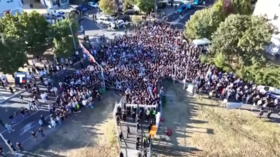
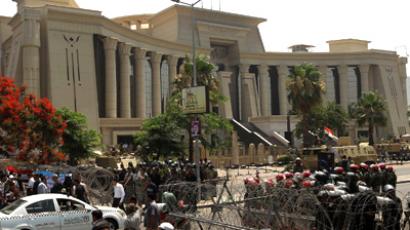
"This declaration is deemed necessary in order to hold accountable those responsible for the corruption, as well as other crimes, during the previous regime and the transitional period," the statement said.Just hours before the statement was announced, police used tear gas to disperse protesters in Cairo, in the third consecutive day of anti-Morsi demonstrations. Officers stormed a sit-in on Tahrir Square as demonstrators gathered to join with dozens of activists that had spent the night in tents to protest the Egyptian president.
But the chaos isn’t just taking place on the streets – a third adviser to the president resigned from his post on Sunday over the declaration, as the country’s stock market plummeted. Morsi met with his remaining advisors and assistants earlier Sunday, to discuss the fallout from the controversial decree. On Sunday Ahmed Fahmi, chairman of the Islamist-dominated Shura Council and a leading member of the Muslim Brotherhood’s Freedom and Justice Party, made a surprising statement condemning the decree. The declaration “has severely divided the nation into Islamists and civilians," Fahmi said. He urged Morsi to conduct a national dialogue with all forces, with an eye to putting an end to the crisis triggered by the decree.On Saturday, prominent Muslim Brotherhood Leader Mohamed Abdel-Qodous also condemned the decree. "I am sorry Mr President. Despite my membership of the Brotherhood, I am a son of the revolution for freedom and I reject the move giving you absolute power, regardless of the reasons behind it or how long it will be in place," Abdel-Qodous said on Twitter.Egypt’s Judges Club has also spoken out against the declaration, calling it a “ferocious attack on Egyptian justice.” Following the decree, the group called for judges to go on strike. On Sunday, the Supreme Judicial Council called for those judges to return to work, Al Arabiya reported.Another judges caucus, Judges for Egypt, has rallied in support of the declaration. Morsi is soon expected to call a meeting with judges.“The situation in Egypt is polarized and there’s fragmented politics. There was a buildup to this tension, with Gaza and Morsi’s lack of imaginative approaches for Gaza – which were no better than Mubarak’s,” Middle East analyst Amro Ali told RT. But the leader did manage to broker a ceasefire between Israel and Gaza on Wednesday. And it’s that ceasefire that many say gave him the confidence to give himself absolute power.“The ceasefire has given him an aura of international legitimacy, and the [$4.8 billion] IMF loan has empowered him to continue with his reforms,” Ali said. As supporters of the Muslim Brotherhood continue to back the leader, Ali says the party isn’t nearly as powerful in urban areas as it is in rural ones – and therefore lacks major influence in many strategic parts of the country. “The Muslim Brotherhood is better at mobilization. It’s not good at public opinion. And the fact that it has to bus in its members from other parts of Egypt means that its strength does not lie in the urban heartlands,” he said.As the protests and political turmoil continue, it appears the situation won’t be fixed overnight. “It’s a big, confusing mess and as someone who reads up a lot on this, it’s really hard to say where it’s going at this point in time,” Ali said.Meanwhile, a number of Egyptian state TV channels disappeared from the airwaves Sunday evening, leaving many to fear possible media censorship. "The connection was broken by sources outside Egypt. Investigations are ongoing to determine the source [of the disconnection]," managing director of NileSat, Salah Hamza, told Ahram Online.