Morsi declares expanded powers, bans breakup of assembly penning constitution

Published time: November 22, 2012 16:16
Edited time: November 23, 2012 03:53
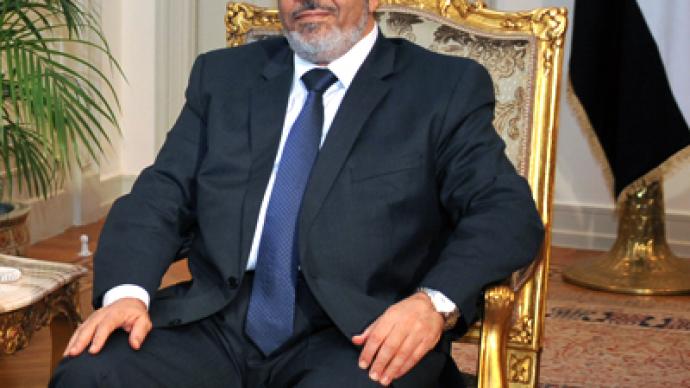
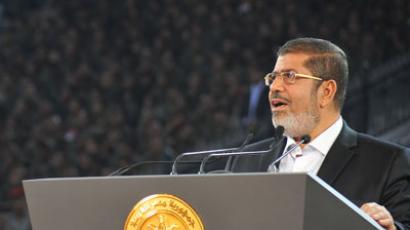
Egyptian President Mohamed Morsi (AFP Photo)

The Egyptian president has issued a constitutional declaration protecting Egypt's constitution-drafting assembly from dissolution, and replacing the prosecutor general. It also rules that none of the executive's decisions can be overturned.

Morsi gave the Constituent Assembly a two month deadline to finish drafting a new constitution, ruling that no authority may dissolve it until the country's defining document is completed.

He further ruled that no authority may dissolve the Shura Council, the upper house of Egypt's parliament.

In a move likely to bring criticism that the Egyptian president is inappropriately expanding his powers, he also decreed that no laws or declarations passed by the president from the time of his inauguration until a new parliament is elected can be overturned by any authority, including the judiciary.

He further dismissed the country's prosecutor general Abdel-Meguid Mahmoud, appointing Talaat Ibrahim to replace him for a four-year term.

Morsi had previously attempted to remove Mahmoud for his part in the acquittal of Hosni Mubarak-era officials implicated in the killings of protesters during last year's popular revolution.

Morsi ordered the retrial of all those charged with killing or injuring protesters involved in the uprising. In addition, all Mubarak-era officials alleged to have terrorized protesters will be retried.

In light of the sweeping powers, Egyptian opposition leader Mohammed ElBaradei accused Morsi of behaving like a "new pharaoh."

In September, Egypt’s high administrative court upheld a controversial June ruling to dissolve the country’s parliament. The move was opposed by Morsi, whose Freedom and Justice Party  (FJP) won more seats in the 2011-2012 parliamentary elections than any other faction.

Morsi threatened to override the move – which was instituted by the country’s military rulers and the Supreme Court of Egypt – once he took office. In July he reversed his position, saying he would respect the court’s decision that the parliament be dissolved.

The fate of the country's burgeoning constitution stands on equally uncertain ground.

A court suspended the country's first 100-member Constituent Assembly in April for being “unrepresentative of Egyptians." The Supreme Administrative Court then dissolved it for containing members of parliament. The court said MPs who were responsible for electing members of the body were not supposed to be serving on it, thus making it unconstitutional.

The current Constituent Assembly – elected in June – also contains members of parliament in contravention to the March 2011 Constitutional Decree. While the country’s military rulers have so far left it in tact, its legal status is equally dubious.

The Constituent Assembly was previously scheduled to present a final draft of the country's national charter by December 5.

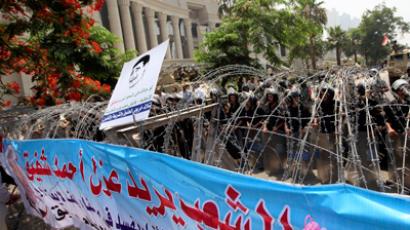
The amendments come as violent street clashes between protesters and security forces in Cairo enter their fourth day. More than 72 people have been injured in the demonstrations, which kicked off on the one-year anniversary of street battles in which 42 people were killed.

Egyptian sources said that members of the Muslim Brotherhood – which founded the Freedom and Justice Party, which Morsi once chaired – have been asked not to leave the country in case they were needed to defend the president’s “revolutionary” decisions.


A young Egyptian protester throws a stone at anti riot policemen during clashes in the Cairo′s Mohammed Mahmoud street on November 22, 2012. (AFP Photo)
A young Egyptian protester throws a stone at anti riot policemen during clashes in the Cairo's Mohammed Mahmoud street on November 22, 2012. (AFP Photo)
Protesters throw stones towards riot police during clashes after a rally to mark the one-year anniversary of fatal clashes at Mohamed Mahmoud street, in the vicinity of the Interior Ministry, in Cairo November 22, 2012. (Reuters / Mohamed Abd El Ghany)
Protesters capture and bind the hands of men, who protesters say attacked them during clashes with riot police after a rally, marking the one-year anniversary of fatal clashes at Mohamed Mahmoud street, in the vicinity of the Interior Ministry, in Cairo November 22, 2012. (Reuters / Mohamed Abd El Ghany)

Comments (45)

africaboy (unregistered) 23.11.2012 16:01

It not because people are protesting about his decision we should assume that decision is not for the interest of people. In Russia we saw people protesting against Putin. In China we saw people protesting against some decision. In Iran we saw the same.  I don't think barring anyone to devolve constitutional body is a bad thing. I don't think as a president asking for more authority in order to govern is a bad thing. Morsi did not win the election with more than 80% of the vote. That means there are many people in Egypt belonging to hold guard will to use any pretest to destroy his authority. Look in Ivory Coast. In year 2000 that country elected a President. The old guard used every means to trash down his power. The formed a rebellion in september 2002 against him. The old guard mainly friend of colonial powers such as the United States and France used the 2010 election in that country to kill and installed on power one of their puppet. So we need to be careful here when we are talking about the Event in Egypt. Morsi came in power without a real authority. How someone can govern without authority.  

0

Undo

GreenLantern (unregistered) 23.11.2012 14:09

This man ran on the pretense of bring freedom liberties to Egypt using 'words"
What is see in his actions "show" "Wahhabi" very Extreme brand of religion.
Woe oh woe to the people of Egypt- that’s what see in their future with this 'Man" of wonderful promises "giving False hope" which is what any man seeking elevated positions over his own will always seek- and will always be corruptible to influences "west or Israel" of more power more control and more wealth. That’s what men with very large EGO’s do and cannot change until they raise their own minds to become a bit WISER.
Here in America they actually cheer for their own executioners.

+1

Undo

Clair (unregistered) 23.11.2012 09:06

to bro Norman
Th at course of events described in Daniels prophecy was foretelling the kingdoms preceding the birth of Lord incarnate and the establishment the ONLY Kingdom that matters in human history –the KINGDOM of our Lord. Those events (Egyptian, Persian, Syrian and Greek etc. yokes) had already taken place when at that time ancient Israelites had lived under different national powers you are referring here to. What is most important, is that God instead had promised the HEAVENLY Kingdom to HIS people and that means not geographical LANDS BUT THE CHANCE OF ETERNAL LIFE-an opportunity than had been lost for the fallen by Adam and Eve humanity . He had stayed to true to HIS promises and made the humanity into communion with Divine nature of Holy Trinity.  That means that each of us is now potentially capable of deification as a relative (even a very distant one) of the Son of God while still being a relative of fallen first man Adam. Meanwhile, most of His “chosen ones” (and most of us now, to be true) had thrived not for heavenly life but for earthly one instead and, subsequently, had rejected and killed the Son of God. Who is closer to being “Beast” now? Egyptians, really? Maybe Copts?

0

Undo

View all comments (45)
Add comment

By posting your comment, you agree to abide by our Posting rules

Log in to comment in full, or comment anonymously under character-limit restriction.

100 Text

– required fields

Register or

Name

Password

Show password

Register

or Register

Request a new password

Send

or Register

To complete a registration check
your Email:

or Register

A password has been sent to your email address

Edit profile

Name

New password

Retype new password

Current password

Save

Cancel

Follow us