Extra space: Largest known spiral galaxy identified by accident
Published 11 Jan, 2013 17:12 | Updated 12 Jan, 2013 12:35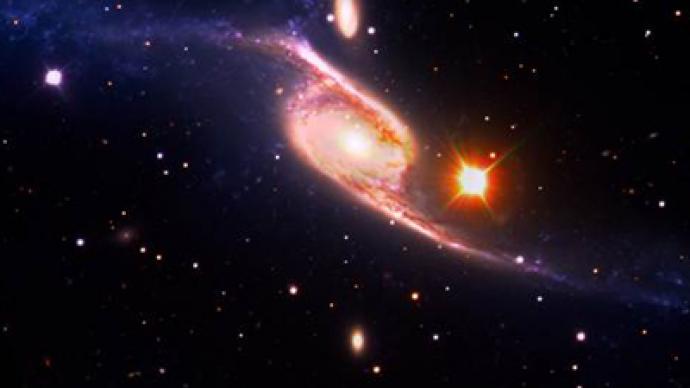
The largest known spiral galaxy in the universe has been accidently discovered by a team of astronomers from the US. Measuring a whopping 522,000 light-years across, it’s over five times bigger than our own galaxy, the Milky Way.
The new find, called NGC 6872, is located about 212 million light years away from Earth. Researchers say they made the discovery after spotting the galaxy through a satellite signal. The astronomers were looking for star-forming regions near to the galaxy. But instead they found a huge amount of ultra-violet light from young stars, which revealed the true scale of the galaxy itself."I was not looking for the largest spiral – it just came as a gift," lead scientist for NASA's Goddard Space Flight Center, Rafael Eufrasio, told reporters.Exploring archival data taken from NASA's Galaxy Evolution Explorer (GALEX) satellite, which is used to monitor star-forming regions, a galaxy named NGC 6872 was earmarked."Without GALEX's ability to detect the ultraviolet light of the youngest, hottest stars, we would never have recognized the full extent of this intriguing system," added Eufrasio.The finding was presented at the 221st meeting of the American Astronomical society in California, which took place in early January. Found in the constellation of Pavo, it also contains the remnants of another galaxy, IC 4970, which contains just one-fifth the mass of NGC 6872, according to researchers.The smaller IC 4970 is believed by astronomers to have crashed through its spiral. This titanic collision happened about 130 million years ago and set off a wave of star formation, which made NGC 6872 the giant that it is today."The northeastern arm of NGC 6872 is the most disturbed and is rippling with star formation, but at its far end, visible only in the ultraviolet, is an object that appears to be a tidal dwarf galaxy similar to those seen in other interacting systems," NASA has quoted astronomy professor Duilia de Mello as saying.The existence of the giant spiral galaxy had been suspected by scientists for decades, but only now, after detailed and careful study of data from different telescopes, including GALEX, the galaxy was able to be crowned champion among all the known spiral galaxies.Eufrasio also stressed spiral galaxies even bigger than NGC 6872 may be out there, but they are still waiting to be spotted and studied in depth.