Japan's ambassador to China dies amid rising anti-Japanese protests (PHOTOS)

Published time: September 16, 2012 10:23
Edited time: September 16, 2012 14:23
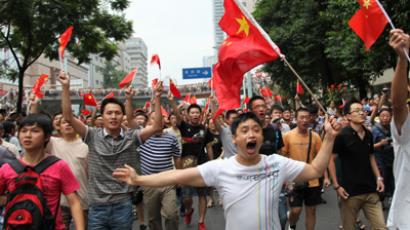
hinese demonstrators carry anti-Japan banners and shout slogans during a protest over the Diaoyu islands issue, known as the Senkaku islands in Japan, in Wuhan.(AFP Photo /  China Out)

The Japanese ambassador to China died in a Tokyo hospital after being admitted three days earlier. His death coincides with an escalation in anti-Japanese protests across China over a territorial dispute.

The cause of ambassador Shinichi Nishimiya’s death is currently under investigation, Japan's Ministry of Internal Affairs said. Three days ago, Nishimiya was found unconscious near his Tokyo home after leaving for work.

A second day of demonstrations took place across China against Japan's territorial claim to a group of disputed islands in the East China Sea. China does not recognize Japan's claim to the isles, which are known to the Japanese as 'Senkaku' and as 'Diaoyu' by the Chinese.

In Shenzhen, a city near Hong Kong in southern China, police dispersed thousands of activists with water cannons. And in the eastern city of Qingdou, witnesses reported smoke and flames coming from a factory owned by Japanese electronics manufacturer Panasonic. A Toyota dealership was also damaged in Qingdou, a company spokesperson said.

In response, Japanese Prime Minister Yoshihiko Noda called on the Chinese government to “ensure the security of Japanese citizens,”  and decried the recent surge of anti-Japanese demonstrations. “I strongly object to the burning of Japanese flags and the protests,” Noda said on a Japanese talk show broadcast by NHK.

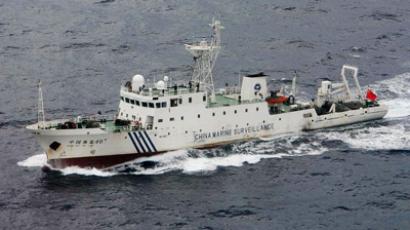
Tensions between the two countries intensified on Friday when six Chinese ships entered Japanese waters near the disputed islands and ignored the Japanese Coast Guard's orders to leave. The move triggered angry protests in hundreds of Chinese cities, some of which were reportedly violent.


A Chinese protester hurls a water bottle during an anti-Japanese protest over the Diaoyu islands issue, known as the Senkaku islands in Japanese, outside the Japanese Embassy in Beijing.(AFP Photo / Goh Chai Hin)

­

Chinese para-military police (bottom) shelter behind a barrier as demonstrators continue to throw eggs, rocks and water bottles during an anti-Japanese protest outside the Japanese embassy in Beijing over the Diaoyu islands issue, known as the Senkaku islands in Japanese.(AFP Photo / Mark Ralston)

­

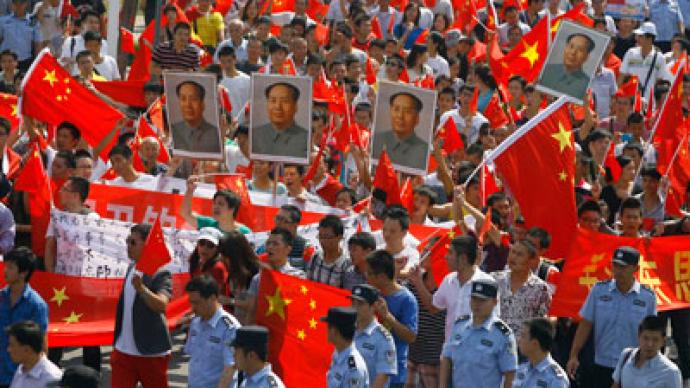
Chinese demonstrators carry national flags and portraits of Mao Zedong during a protest over the Diaoyu islands issue, known as the Senkaku islands in Japan, in Wuhan.(AFP Photo /  China Out)
Chinese demonstrators carry national flags and portraits of Mao Zedong during a protest over the Diaoyu islands issue, known as the Senkaku islands in Japan, in Wuhan.(AFP Photo / China Out)

­

Chinese protesters hurl water bottles during an anti-Japanese protest over the Diaoyu islands issue, known as the Senkaku islands in Japanese, outside the Japanese Embassy in Beijing.(AFP Photo / Goh Chai Hin)

­

Chinese protesters hurl water bottles during an anti-Japanese protest over the Diaoyu islands issue, known as the Senkaku islands in Japanese, outside the Japanese Embassy in Beijing.(AFP Photo / Goh Chai Hin)

­

Chinese para-military police look at various items through lying on the ground during anti-Japanese protests outside the Japanese embassy in Beijing over the Diaoyu islands issue, known as the Senkaku islands in Japanese.(AFP Photo / Mark Ralston)

­

Chinese para-military police walk behind a barrier as demonstrators continue to throw eggs, rocks and water bottles during an anti-Japanese protest outside the Japanese embassy in Beijing over the Diaoyu islands issue, known as the Senkaku islands in Japanese.(AFP Photo / Mark Ralston)

­

Chinese demonstrators carry anti-Japan banners and march during a protest over the Diaoyu islands issue, known as the Senkaku islands in Japan, in Wuhan.(AFP Photo /  China Out)
Chinese demonstrators carry anti-Japan banners and march during a protest over the Diaoyu islands issue, known as the Senkaku islands in Japan, in Wuhan.(AFP Photo / China Out)

Comments (40)

Saygo Takecaremory (unregistered) 18.09.2012 08:59

Oh, just another US led deception so that China is pre-occupied with pony Japan and other so called independent countries like the Philippines et c when the US and its white allies invade and ransack Iran.

+1

Undo

Davidm 18.09.2012 08:49

The dispute over the Senkaku/Diaoyu islands in fact dates back to the first Sino-Japanese war of 1894-5; it was in 1895 that Japan took control of the rocky outcrops, which lie close to Taiwan rather than mainland China (let alone Japan). While I was in Tokyo I had the benefit of discussing this issue with Professor Shinichi Kitaoka, the former Japanese ambassador to the United Nations, who as an eminent academic historian was the Japanese chairman of the Japan-China Joint History Research Committee which investigated the Nanking Massacre.Shinichi pointed out what is not in dispute: that the islands had long been administered by Japan and that they had never physically been occupied by China. He added that it was only in 1968 when it was discovered that the seabed around the islands could contain oil reserves that China raised the issue of sovereignty. He observed that Taiwan also lays claim to the islands; and, with a smile, added that the People’s Republic of China makes its own claim precisely through the belief that Taiwan is itself wholly and indivisibly part of its rightful territory.Shinichi, a veteran of these disputes, told me that one of the problems he had found when discussing such matters with negotiators from the People’s Republic was that over the years they would come up with different “official” views over what constitutes China’s legitimate territory: “Sometimes they would tell us ‘The Korean peninsula is ours’. On other occasions they would even show us maps on which all Asia apart from Japan and India is designated as China.”

0

Undo

Guynirnam (unregistered) 17.09.2012 22:51


both nations had impeccable military records. Japan we all know where military ambition had led them to. China on the other hand, invaded Burmar four times, all four generals were captured, sodomised and sent home on those occasions with one who was a son-in-law of the man who run Chinese government at the time decided to hang himself in the wood of Burmar. Go on and fight if you haven't learn the lesson already!

0

Undo

View all comments (40)
Add comment

By posting your comment, you agree to abide by our Posting rules

Log in to comment in full, or comment anonymously under character-limit restriction.

100 Text

– required fields

Register or

Name

Password

Show password

Register

or Register

Request a new password

Send

or Register

To complete a registration check
your Email:

or Register

A password has been sent to your email address

Edit profile

Name

New password

Retype new password

Current password

Save

Cancel

Follow us