Our neighbor star almost as old as universe

Published time: January 13, 2013 07:50
Edited time: January 13, 2013 11:50
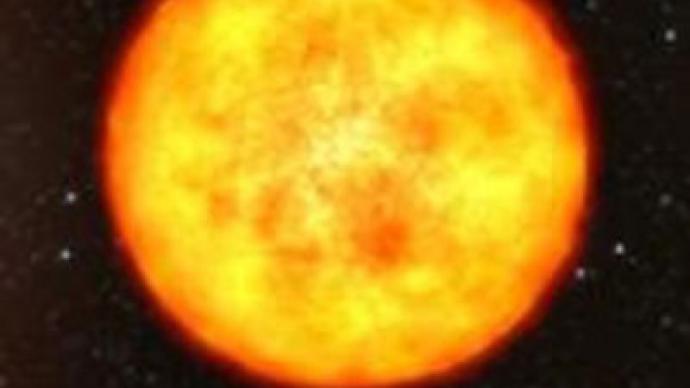
HD 140283.(European Southern Observatory)

A long-known star in the relative proximity to the Solar System is the oldest among the billions humanity has studied. Formed shortly after the Big Bang, it’s now at least astounding 13.2 billion years old.

­The star dubbed HD 140283 lies just 190 light years from us and has been known to astronomers for more than a century, reports Nature magazine.

Scientists were aware that it must have formed early because it consists almost entirely from hydrogen and helium. Heavier elements simply had not been produced in large quantities by the previous generations of stars by that time and were not present in the primordial gas, from which the stars coalesce.

But the exact age of HD 140283 was not known until Howard Bond, an astronomer at Pennsylvania State University in University Park, and his colleagues took a closer look at it. The team made a new and more accurate calculation of the star’s distance from the Solar System using a collection of 11 sets of observations taken between 2003 and 2011.

Then they determined its intrinsic luminosity. With HD 140283 being in the later stage or its evolution having almost depleted the hydrogen fuel in its core, the luminosity is a highly-sensitive indicator of the star’s age.

Bond and his team calculated that the star is 13.9 billion years old. This actually places it beyond the time that the universe exists. The current estimate is that the Big Bang happened some 13.77 billion years ago. This is explained by an experimental error, which may be as large as 700 million years. So the star is at least 13.2 billion years old and may be several hundred million years older than that.

The age is comparable to that of the star known as Methuselah. But Bond believes HD 140283 must be older, as its age has been determined with better confidence.

“We believe this star is the oldest known in the Universe with a well determined age,” Bond said this week as he reported the discovery at a meeting of the American Astronomical Society in Long Beach, California.

Judging by the trace amounts of elements heavier than helium in it, HD 140283 must have formed after the death of the first short-lived generation of stars, which produced those elements.

Later generations could have started forming only after the gas heated by the explosions of those early stars had cooled down enough. The age of HD 140283 indicates that this had happened earlier than astronomers thought.


Comments (61)

A. Patriot (unregistered) 14.01.2013 08:49

When that star begins fusion Helium it should grow brighter imo as it takes more energy to fuse Helium than Hydrogen and should this star run low on Helium, it would quickly burn thru it's few heavier elements in short order.

If this star contains any amounts of Iron then it would go super nova in an attempt to fuse Iron (the star killer) or failing that collapse into a dwarf white star (more likely) which would begin beaming potent X-rays and Cosmic rays in relative short distance to the earth (190 light years).

Any of the above scenero's would directly impact the earth in minimal to substantial ways and yet there doesn't seem to be a single mention about the in the article.

What seems odd is that the Milky Way isn't at the center of the Universe and yet this Star's alleged birth would place it at such a position. The enormous amounts of Iron on earth and likely Mars seems to indicate complete odds in being in near astrometric proximity to a Star with nothing but Hydrogen and Helium as elements.

0

Undo

Krestovan 14.01.2013 06:49

Couple of chaps won a Nobel prize for discovering 'big bang' microwave background radiation. Recent satellites improved on their earlier discoveries. But the 'big bang' is still itself unseen even tho it 'banged' or 'inflated' fast and produced this radiation as a result, they say. Sorry guys; smells real bad. But what banged. From nothing to a life giving universe in a microsec? Tell me another one. 'Tell you what: have a cool, juicy slice of watermelon on a hot day and figure the mathematical luck of both of you 'evolving', simultaneously. And a million other neat things to. 

0

Undo

Mechta (registered) 14.01.2013 05:07

Robert (unregistered) wrote in #1
I'm worried. If this star is that old then when will it die and how will it die. If it explodes then we may be killed by it. Someone investigate and get back with me please.
We already know that old stars die out. So instead of being afraid of that, it would be more productive to develope long distance space travel rather than spending billions on useless information like how old the Universe is. We don't even know when our Sun will die out.    

0

Undo

View all comments (61)
Add comment

By posting your comment, you agree to abide by our Posting rules

Log in to comment in full, or comment anonymously under character-limit restriction.

100 Text

– required fields

Register or

Name

Password

Show password

Register

or Register

Request a new password

Send

or Register

To complete a registration check
your Email:

or Register

A password has been sent to your email address

Edit profile

Name

New password

Retype new password

Current password

Save

Cancel

Follow us