Bloggers’ fear: Russian crackdown on illegal web content causes stir

Published time: November 13, 2012 12:48
Edited time: November 14, 2012 05:00
(AFP Photo / Getty Images)

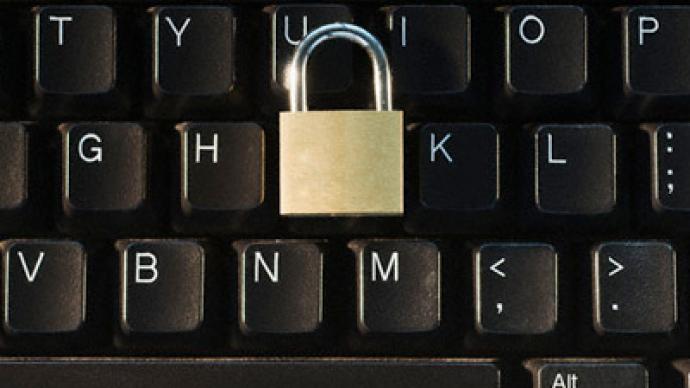
Public discontent over a ban on popular websites in the Russian sector of the internet is skyrocketing. The new law allowing authorities to compel ISPs to cut off unwelcome websites may force web surfers to unite against the government’s initiative.

­The federal law ‘On information, information technology and protection of information’ that came into force on November 1 empowered Russia’s Federal Supervision Agency for Information Technology and Communications to compose a blacklist of websites to be closed down.

The uniform register of prohibited websites, officially confidential, is constantly expanding. The list unites porn resources, file-sharing communities, websites dedicated to drugs or containing related information, websites dedicated to terrorist activities, pedophilia etc. 

The Supreme Court of the Russian Federation in a recent ruling called to ban online casinos and to oblige providers to eliminate links leading to such web resources.

The uniform register now reportedly consists of over 180 websites, some already defunct, others still operational. 

An interesting fact about how the Information Agency tracks ‘bad’ websites is that anyone can anonymously submit a URL or an IP of a web resource the informer believes poses a threat on the official website of the agency. The information will be verified and if prohibited material is found there, the website will be closed.

The owners of large and popular web portals say they are ready to cooperate with authorities, deleting certain pages containing unwelcome information.

For example popular file-sharing site Rutracker.ru was included on the black list for sharing the ‘Encyclopedia of Suicide’. The portal was forced to delete the offending file. As of Wednesday Rutracker.ru was no longer on the list.

Another popular website, encyclopedia of modern culture Lurkmore.ru, was initially banned because of a vast page dedicated to drugs. The owner took the decision to ban access to the drug page and the website has been excluded from the blacklist. 

Some web surfers observed wryly that banning the drug page on Lurkmore.ru ‘definitely’ made the Russian internet a safer place now. But they also pointed out that the deleted page contained fierce critics of the Federal Drug Control Service of the Russian Federation, putting the service’s working practices and the results of their decade-long activities in a negative light.

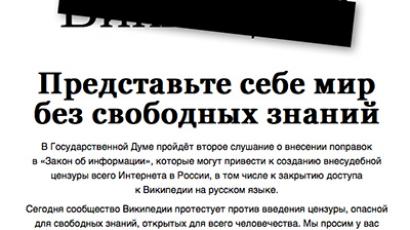
The web encyclopedia of modern culture Lurkmore.ru reacted to the ban of its content by posting a self-censored article “Censorship” and sarcastically shading almost the entire piece. Screenshot from lurkmore.to

RuNet surfers are currently busy discussing the fact that immensely popular internet library Lib.Rus.Ec has also been considered containing prohibited materials. Reportedly, Lib.Rus.Ec has been banned for having a text of ‘Anarchist’s cook book’, containing a recipe for hemp soup.

At the same time the authorities refused to delete without a court’s decision the social network webpage of mass killer Dmitry Vinogradov, who shot dead six colleagues on November 7, because it does not contain porn, suicide or pedophilia materials. In reality, before going to the massacre, Vinogradov published on his page a ‘hate manifesto’, saying that he hated the human race. Since the mass murder the ‘manifesto’ has been read by many thousands of users, over 18,000 of which ‘liked’ the text.

There are no signs that Russian web surfers are going to show the white flag and give up the free-for-all approach of the global web. Discussions on how to bypass the restrictions are hot and their general advice is predictable.

Internet users propose actively using web-proxies, creating mirrors of the banned sites and changing IP addresses. 

Web surfers predict fast growth of illegal activities over the web as the result of introduction of the new restrictions, which open massive opportunities for web blackmail, fraud and trade of ‘illegal’ materials.

Still, the internet users say, the uniform register of prohibited websites can be put to a proper use.

“That’s marvelous. Now, after light editing out real s*** out of this, we have in the bottom line the ‘must see and read’ list of the RuNet,” bloggers say.


Comments (9)

guest (unregistered) 14.11.2012 14:26

Q,
"Well, all sources of information that I'm interested in are accessible for me without proxies etc, so I don't see how my freedom was infringed. "
Tha t's because you are a pro-putin "patriotic" vegetable with no imagination, and you do not need anything more than Channel 1's evening "news".Draconian laws can be smelled from a mile away, and as I said various things like pedophilia, drugs, terrorism etc are often nothing more than an EXCUSE to ban something.But again this is so wrong and hypocritical a kindergartener w ould figure this out: drugs are illegal. Yet there are vodka commercials on Russian TV... no seriously, shouldn't that be a priority? Or for example the drug Kloaksil freely sold in all kiosk-type "pharmacies" in Russia - why aren't they raided by police? Why are they still operating? Again, actual Russian law PRACTICE is a joke like I said. 
"Producti on, distribution or storage for the purpose of distribution are illegal."
So yes it is illegal to own one, because that law can be twisted any way you like. A typical vague multi-purpose law and typical apologetism from you.
Say aren't you the guy who "covered the machinegun nest with his body" when there was a big discussion around the bling-pope Gundayev, his gang of hypocritical gangsta "men of the cloth", maybachs, clocks, palaces, illegal alcohol and prescious metal sale, etc?

0

Undo

Q (unregistered) 14.11.2012 07:58

guest (unregistered) wrote in #6 > Want another example? A blogger (his name escapes my mind) wrote an article critical of Putin - his blog was obviously deleted and he ended up in jail for "offending" the president. Another draconian example of nothing other than political censorship.

B S. Russophone internet is full of blogs, posts, comments, articles, anything else that are critical of Putin, government, and anything else. Many people are bored with this so much that they would be happy if those who write it were jailed, but it doesn't happen.

I bet that if you would be able to remember blogger's name, we'd find out that he was jailed for something else. 'Being critical of Putin' is a usual excuse of 'opposition' for anybody jailed for any possible crimes (e.g. PRiots). So I understand why you don't want to tell us the name of a 'jailed blogger'.

One more example - radio "Echo of Moscow" - it's very critical of Putin, even though actually it's indirectly owned by the Russian government. Somehow the staff of that radio wasn't jailed yet. Government or Putin aren't even trying to interfere in editorial policies. Another example - TV channel "Rain", they aren't jailed yet too.

There are a lot of anti-Putin and anti-government newspapers and other media in Russia, tell me please how many of them were oppressed, taken down, closed, owners jailed, etc. You can't, because it happens only in the imagination of the so-called opposition.

0

Undo

Q (unregistered) 14.11.2012 07:53

guest (unregistered) wrote in #6 > Russian justice system per today is nothing more than political policy enforcement, and has nothing to do with practicing law, so until that gets fixed I'd advise everyone to get a proxy, or better yet premium VPN or Thor and avoid all this infringement on personal freedoms.

Wel l, all sources of information that I'm interested in are accessible for me without proxies etc, so I don't see how my freedom was infringed. Fortunately, I'm not really interested in sites about suicide or drugs, as well as pedophilic sites, extremist sites, or sites with fake history. So it doesn't infringe my freedom, at least not more than the law that prohibits me from killing the people, because I'm not going and don't need to kill anyone. Actually, any law limits your abstract freedom, yet humanity invented the laws and uses them for milleniums, because the needs of society are more important than the abstract freedom of one person. Your freedom ends where my freedom begins, and for somebody free internet may mean the internet free of cp, drug-selling sites, extremist sites etc, so one might consider that law as a freedom enforcement.

> To give you an example of this political censorship - take Mein Kampf. Now not everyone that owns the book needs to be a neo-nazi, histo rians often use the book, film makers, history buffs, people studying political science, psychology students etc. In Russia however it is illegal to own one.

I think you should read the laws before discussing them, if only lying is not your intention. It's not illegal to own it. Production, distribution or storage for the purpose of distribution are illegal.

0

Undo

View all comments (9)
Add comment

By posting your comment, you agree to abide by our Posting rules

Log in to comment in full, or comment anonymously under character-limit restriction.

100 Text

– required fields

Register or

Name

Password

Show password

Register

or Register

Request a new password

Send

or Register

To complete a registration check
your Email:

or Register

A password has been sent to your email address

Edit profile

Name

New password

Retype new password

Current password

Save

Cancel

Follow us