The Ukrainian-Russian brotherhood: forged in blood, broken by gas
Published 4 Jun, 2009 09:56 | Updated 4 Jun, 2009 13:56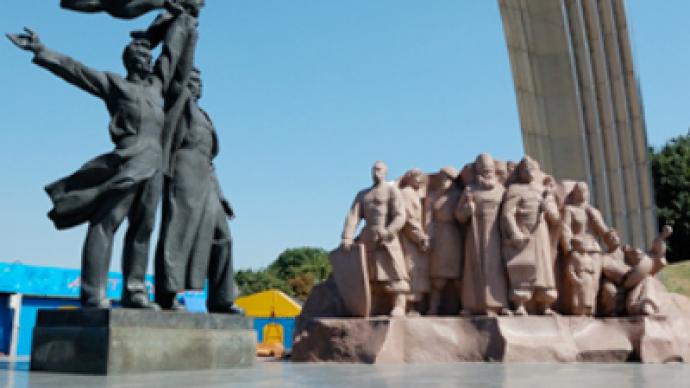
There are few feuds more dreadful than family feuds, where common blood excites both love and hatred, and familiarity breeds a never-ending contempt. And so it is with Ukraine and Russia.
For centuries, the territory now known as ‘Ukraine’ was practically synonymous with Russia, and vice versa. But since the collapse of the Soviet Union, and the rise of nationalistic passions across the CIS, relations between Moscow and Kiev have come to resemble a bitter battle between competitive siblings.
A quick trip through Ukraine-Russian history
The deep relationship that exists between Ukraine and Russia is not simply rhetorical, as is sometimes assumed in the West. The very name 'Kievan Rus,' the historic birthplace of the ‘Slavic brotherhood’ of Belarus, Ukraine and Russia, imparts a historical linkage between Muscovy and Kiev that cannot be ignored. Indeed, Kievan Rus represents one of the most epic struggles of a people ever told.
The most accepted version tells the story of Rurik, a Viking chieftain from Scandinavia who was invited to extend his rule over the various Slavic tribes in and around Novgorod, Russia.
In 860, Rurik advanced on Kiev, thereby making the present-day capital of Ukraine the political and economic epicenter of Kievan Rus. This medieval state thrived as Europe’s largest trading center until the 12th century, shortly before the catastrophic collapse of Constantinople.
“For millennia… the fertile steppes of the Ukraine had been overrun by nomadic tribes,” Johanna Hubbs writes in her book, 'Mother Russia.' “Attacks on the Kievan principality continued through the thirteenth century… The Mongol hordes led by Batu Khan, took the Ukraine and central Russia with shamefully little resistance from her feuding defenders.”
At this point, Moscow – following its breathless march through history from the Tsardom of Muscovy (1547-1721) to the Holy Russian Empire (1721-1917) until the Soviet Union (1917-1991) – began its inexorable ascendance over the entire region.
Indeed, Moscow’s rise was so spectacular that it is tempting to ask: Is Kiev’s contempt for Russia partially explainable as a case of sheer jealousy; the resentment of an older sibling watching his younger brother win prestige, not to mention power, on the international stage?
Whatever the case, the histories of these rambunctious ‘stepbrothers’ were doomed, or predestined, to be forever intertwined.
Perhaps the one historical event that sealed Ukraine and Russia’s fate to one common destiny occurred in 1654. With the Cossack territory on the verge of being gobbled up by the sprawling Polish-Lithuanian Commonwealth, Bogdan Khmelnytsky, the hetman of the Zaporozhian Cossack Hetmanate, asked his fellow Cossacks who they would like to be united with: the Swedish king, the Turkish khan, the Polish prince…? His men, according to the story, shouted in unison: “Russia!”
So what is Ukraine? How can it be defined? Can Ukraine exist without Russia, and vice-versa? Maybe the answer is to be found in Nikolay Gogol’s story, 'The Enchanted Spot': “They’d plant it right, but what came up you couldn’t say: it’s not a watermelon, it’s not a pumpkin, and it’s not a cucumber… devil knows what it is!”
In fact, the term ‘Ukraine’ did not appear in archives until the 17th century, and when it does appear, it is in passing reference to ‘the Edge’ (which is translated as ‘Ukraine’ in Russian). Later, in Soviet times, Ukraine had been handed the status as the Ukrainian Soviet Socialist Republic, and even had its own representative at the United Nations. It was not formally recognized as an independent state until August 24, 1991 with the collapse of the Soviet Union.
Happily, there is at least one thing that will remain predictable between the shared histories of Ukraine and Russia: it will never be agreed upon. For the foreseeable future, Moscow and Kiev will continue to criticize each others’ school text books and interpretations of their dual history, while the always-biased historians will continue to write their essays more from the heart than the brain.
Geopolitical lynchpin
Ukraine’s geopolitical significance is yet another indisputable fact. Ukraine, the second largest country in Europe in terms of landmass (second only to Russia’s European half), with a population of 47 million, remains a major geopolitical component in this tumultuous part of the world.
Adolf Hitler, for example, in his fanatical desire to create German lebensraum, opened Operation Barbarossa (June 22, 1941) with a massive attack on Ukraine (the breadbasket, he prematurely proclaimed, for the table of his future Nazi empire), instead of making a direct lunge for Moscow, as his generals strongly advised.
Over half a century later, Ukraine’s pivotal positioning on the Eurasian map, which sits directly on the active fault line between east and west, continues to make geopolitical strategists salivate.
Ukraine “is certainly not a pawn,” proclaimed the US geopolitical guru Zbigniew Brzezinski, in an interview with Kiev’s Weekly Digest (May, 2004). “It may not be a queen, but it certainly is an important element on the chessboard – one of the most important.”
It is exactly this sort of geopolitical grandstanding, combined with the harsh reality of NATO’s eastward grind, which made Prime Minister Vladimir Putin warn the West about cozying up to Kiev.
The most egregious example of this ‘cozying up’ occurred during the so-called Orange Revolution in the capital of Kiev, when thousands of protesters took to the streets when run-off votes suggested that the pro-Russian candidate Viktor Yanukovich had taken a comfortable lead over Viktor Yushchenko.
Ukrainian politics, never a rational beast on the best of days, was left in limbo for two months until Yushchenko, inaugurated on January 23, 2005, was finally declared the winner. Moscow accused the West, and specifically the United States, of underwriting Yushchenko to the tune of hundreds of millions of dollars, funneled to Kiev under the cover of a host of non government organizations.
Alas, it is not so ironic that Yushchenko’s popularity is presently stuck in the basement, while Yanukovych looks set to become the next Ukrainian president. But the main lesson is that Moscow will no longer watch complacently as the West plays political games in Russia’s backyard.
This was made clear on May 25 when Putin, following a wreath-laying ceremony to Anton Denikin, a Polish-born commander in the White Army that fought the Bolsheviks following the Revolution of 1917, told journalists: “He (Denikin) had a discussion there about Big Russia and Little Russia – Ukraine,” Russian media reported. “He says that no one should be allowed to interfere in relations between us; they have always been the business of Russia itself.”
Putin’s comments made no small impact beyond the walls of the Donskoy Monastery in Moscow, Denikin’s burial site, especially since the debate over Russia’s rightful place in the annals of Ukrainian history continues to stir up the greatest emotions. Indeed, the comments could be interpreted not just as a warning to the West, but a veiled threat to Kiev that it should be careful to watch its step. After all, Moscow has no shortage of ways to turn up the pressure on Kiev.
Ethnic Russians make up close to 18 percent of Ukraine’s total population, while the figure jumps as one approaches the border with Russia. Meanwhile, in the hotly disputed Crimea, the site of Russia’s Black Sea Fleet, over 58 percent of the population is ethnic Russian, while Russian is spoken in about 95 percent of the households. These people show their political colors every time a NATO ship pulls into dock.
Yet Ukraine understands better than anybody its strategic value, and Kiev seems to get supreme satisfaction playing Moscow and Washington off of each other. For the 28-nation North Atlantic Treaty Organization (NATO), Ukraine represents a convenient land bridge into Russia’s soft underbelly. Indeed, getting Kiev on board this archaic Soviet-era ship seems to be the organization’s greatest pet obsession.
For Russia, Ukraine – besides serving as a (somewhat) reliable transit route for its gas exports to European markets – is a vital landmass that would absorb, or at least slow down, any hypothetical attack that might emerge from the West.
NATO has already signed up Estonia, Latvia and Lithuania, the insanely anti-Russian Baltic countries that all border parts of Russian territory. And with ongoing speculation over a US missile defense system in the Czech Republic and Poland, Moscow will fight against any further NATO-ization in its sphere of interest, and that means Ukraine, and to a lesser degree perhaps, Georgia.
In light of this turbulent history between Ukraine and Russia, the perennial problem involving gas shipments to Ukraine from Russia is really only a lightning rod for the accumulated history of discontent and dissension between the two nations. If there were not gas supplies to bicker over, Moscow and Kiev would certainly find another source of disagreement.
But hopefully the ongoing antagonism will amount to nothing more tragic than two competitive brothers who, argue though they may, will never forsake the other due to their common heritage.
Although it is not impossible to imagine such a turn of events, at the same time we may be sure that the relationship will never epitomize the famous speech in Nikolai Gogol’s classic novel "Taras Bulba," which schoolchildren from the Soviet period committed to memory: “No, brothers, to love as the Russian soul loves is to love not with the mind or anything else, but with all that God has given, all that is within you.”