Harvard professor looks for 'adventurous woman' who agrees to give birth to cloned Neanderthal
Published 21 Jan, 2013 20:48 | Updated 22 Jan, 2013 00:48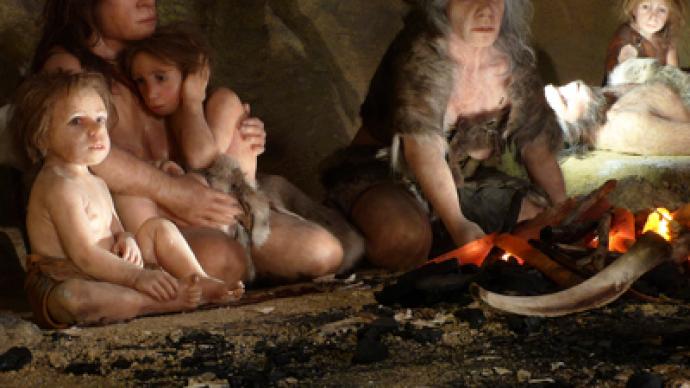
Prehistoric men may soon be walking the earth again. One of the world’s leading geneticists is in search of a female volunteer to give birth to a Neanderthal – a species that went extinct more than 33,000 years ago.
Using DNA from Neanderthal bones, Harvard Medical School Professor George Church plans to resurrect the long-extinct relative of man by implanting a cloned embryo into the womb of a surrogate mother.“We can clone all kinds of mammals, so it’s very likely that we could clone a human,” he told the German magazine, Der Spiegel. “Why shouldn’t we be able to do so?”Church, a 58-year-old pioneer in synthetic biology, helped create the Human Genome Project in the 1980s and has been involved in instituting numerous biotech firms. He is working toward making humans resistant to all viruses, as well as recreating the Neanderthal. Church believes he has the Neanderthal genome and the technology to bring a prehistoric man to the earth. All he needs is an “extremely adventurous female human” and laws that would make cloning legal to begin his experiment.“It depends on a hell of a lot of things, but I think it can be done,” he said.The professor would first create the DNA based on a genetic code found in Neanderthal fossils. This DNA would then be put into stem cells, injected into cells from a human embryo and finally placed into a surrogate mother. Church believes the stem cells would cause the embryo to develop into a Neanderthal, rather than a human.But creating a half-human, half-Neanderthal is not impossible – and might even be beneficial to bring increased diversity to Earth, according to the scientist.“It could even be that you want just a few mutations from the Neanderthal genome,” he said. “Suppose you were to realize: Wow, these five mutations might change the neuronal pathways, the skull size, a few key things. They could give us what we want in terms of neutral diversity. I doubt that we are going to particularly care about their facial morphology, though.”Church also believes that a Neanderthal society could contribute a new thought process that would lead to new ideas.“Neanderthals might think differently than we do. They could even be more intelligent than us,” he said. “When the time comes to deal with an epidemic or getting off the planet, it’s conceivable that their way of thinking could be beneficial.”Although the scientist’s plans might cause some to think back to “Jurassic Park”, Church does not believe it is possible to recreate the dinosaurs and older ancestors of man, like the Homo erectus. The limit for finding DNA fragments is around a million years, he said.But the discussion of cloning won’t lead to action in the US as long as anti-cloning laws and policies continue to remain in place. Many countries, including the US, have banned all forms of human cloning. The United Nations Declaration on Human Cloning, which was adopted in 1997, called on member states to “prohibit all forms of cloning inasmuch as they are incompatible with human dignity and the protection of human life”, prompting the US to come up with its own set of federal laws when DNA technology became advanced enough to make human cloning feasible.Some scientists believe cloned humans would not be accepted in modern society, while others are concerned the genetically engineered beings would lack immunity to diseases, become deformed, or be treated unethically. Church admitted that his work might not be the ‘desirable’ thing to do, but continues to focus on the possibilities of technology.“I tend to decide on what is desirable based on societal consensus. My role is to determine what's technologically feasible. All I can do is reduce the risk and increase the benefits,” he said.