California nuclear plant shut down over radioactive leaks
Published 1 Feb, 2012 18:23 | Updated 1 Feb, 2012 22:36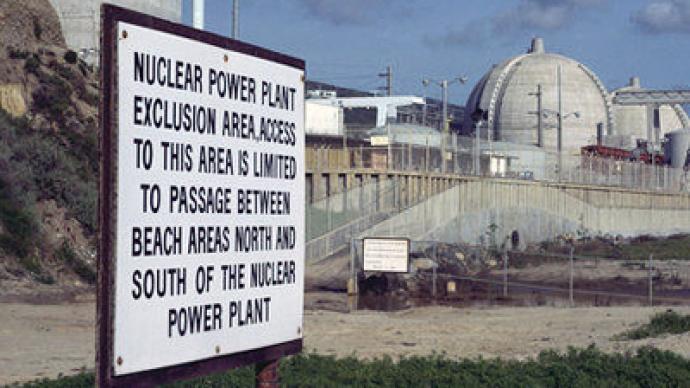
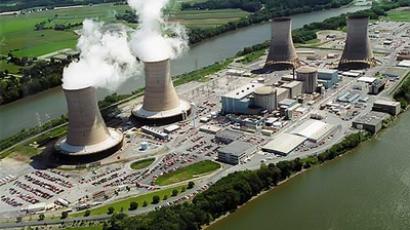
A leak at a Southern California nuclear facility that regularly provides power to roughly 1.4 million households has caused the plant to shut down a reactor.
Despite officials insisting that everything will be perfectly alright at the San Onofre nuclear site, this is not the first time as of late that power plants have raised serious questions about their safety in America. A reactor at the San Onofre nuclear power station was halted Tuesday afternoon after personnel at the plant identified a leak in a steam generator tube. Gil Alexander, a spokesman for Southern California Edison, explains to Reuters that the reactor will remain offline for at least a couple of days."We don't expect any impact on our customers tomorrow," Alexander adds, yet notes that the reactor in question usually churns out around 1,100 megawatts of electricity to one of the biggest metropolitan areas in the country. The shutdown is forcing officials to halt operations in Unit 3 of the plant. Unit 2 of the station was already offline at the time of the incident, of which officials say was the result of routine maintenance and upgrades. Speaking of the alleged minuteness of the leak, Alexander tells the Los Angeles times that “it wouldn’t even qualify as the least severe” infraction under guidelines set up by the United States’ Nuclear Regulatory Commission. Regardless, the plant, located south of San Clemente, California, reported the incident to them anyway. As it would be, the regulations in place for American facilities are actually more lax than one would expect."While the NRC and the nuclear industry have been reassuring Americans that there is nothing to worry about – that we can do a better job dealing with a nuclear disaster like the one that just happened in Japan – it turns out that privately NRC senior analysts are not so sure," Edwin Lyman, a Union of Concerned Scientists nuclear expert, explained to Reuters last year. Even after the nuclear disaster at Japan’s Fukushima plant in early 2011 raised questions internationally over safety regulations, the United States has done little to improve conditions since.The reason, some say, is that the regulations in place don’t call for them. In a report conducted by the Associated Press last year, it was revealed that the Nuclear Regulatory Commission has repeatedly weakened safety requirements for facilities, regularly allowing antiquated plants to continue operating by making it easier to pass tests in lieu of actually upgrading the facility. The AP found that of the 104 nuclear plants operating in America last year, 66 of them had been re-licensed for an additional 20 years of service. The vast majority of plants in the US, however, are already older than a quarter of a century. San Onofre, located around 70 miles south of Los Angeles, is one of those.“I think we need nuclear power, but we can’t compromise on safety. I think the vulnerability is on these older plants,” engineer Richard T. Lahey Jr., formerly with General Electric Co, told the AP last year. Although one-fifth of the nation’s power comes from nuclear plants — and much of Southern California relies on the San Onofre, loosened regulations are repeatedly putting much of America and the world at risk.The San Onofre facility was opened in the late 1960s and has been upgraded since then, although not without incident. Engineers at the Bechtel Group Inc. of San Francisco installed a 420-ton nuclear reactor vessel at the facility in 1977, only to be publically humiliated when it was realized that the plant was constructed backwards. Authorities at San Onofre say that the leak has yet to spread outside of the plant, but should that happen the consequences could be catastrophic. The San Onofre facility is only a stone’s throw away from the Pacific Ocean. The AP adds in their analysis that roughly 113 alerts at the nation’s nuclear facilities since 2005 can be blamed in part on aging. The Nuclear Regulatory Commission itself reported in 2008 that 70 percent of potentially serious safety problems stem from “degraded conditions.” Within the last year, a nuclear plant outside of Washington, DC was shut-down after concern of damage to reactors. In August 2011, officials questioned authorities at Vermont’s Yankee nuclear plant after water samples in a nearby stream tested positive for a carcinogenic chemical.