Pentagon ‘dumbs down’ aviation tests for underperforming F-35
Published 12 Feb, 2013 17:54 | Updated 12 Feb, 2013 21:54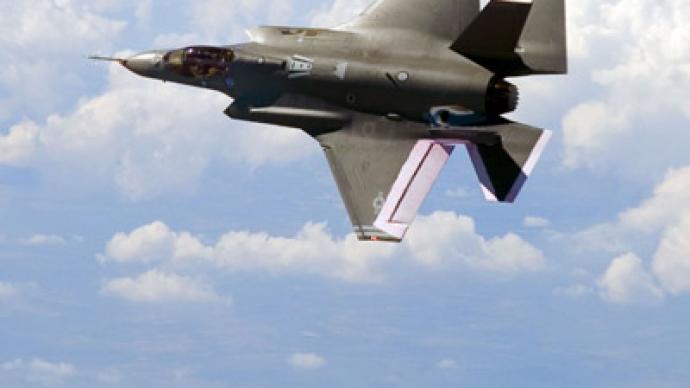
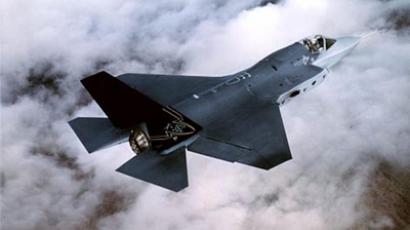
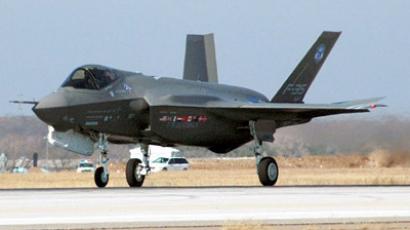
America’s latest stealth fighter jet is too heavy and slow to pass performance tests. Instead of improving the aircraft, the Pentagon has decided to lower its expectations. Experts say the F-35 is more vulnerable than the jet it’s replacing.
Simply put, the F-35 Joint Strike Fighter (JSF) doesn’t go as fast, turn as sharply or handle as gracefully as it should. But instead of bringing in a team of aviation experts to fix the problem, the Pentagon has chosen to accept that the jet underperforms.In an 18-page annual weapons testing report, the Pentagon outlined changes to its rulebook, which include amending performance specifications and increasing time for acceleration for the JSF. “These changes were due to the results of air vehicle performance and flying qualities evaluations,” the report read.The JSF’s reduced performance means the aircraft might not be able to compete with the latest Russian and Chinese-made fighters. Even before the downgrades, some analysts questioned the F-35′s ability to defeat newer Sukhoi and Shenyang jets, Wired reported.The news comes after US taxpayers worked to pay for the stealth fighter program’s $1-trillion price tag – the most expensive in US history. It’s the second time in a year that the US government has eased the performance requirements of the aircraft.In January, the military granted the F-35 a longer takeoff run than originally required and adjusted the plane’s standard flight profile in order to compensate for some of the flying range lost to increasing weight and drag.It’s not the first time the F-35 series has faced setbacks. Last month, the F-35B was banned from traveling within 25 miles of a thunderstorm amid fears that lighting could cause its fuel tank to explode.And last year, the Air Force suspended operation of its fleet of 20 Joint Strike Fighters after they experienced malfunctions – the third time the program was put on hold.Previous tests revealed a number of problems, including excessive vibration, a malfunctioning high tech helmet display and a flawed tail hook that failed to catch arresting gear wires on aircraft carriers.As the US government continues to stress its need for a strong military, the F-35 appears to be anything but intimidating, and is believed to be vulnerable than the jet it is replacing. But the continuous problems faced by the aircraft haven’t stopped the plane’s maker, Lockheed Martin, from praising the fighter jet. The company said the plane is still the second-most maneuverable warplane in existence.Company test pilot Billy Flynn told Flight Global that the JSF accelerates better and flies at higher angles than every other fighter jet, except Lockheed’s F-22. “The F-35 is comparable or better in every one of those metrics, sometimes by a significant margin,” Flynn said.But others in the aviation business were quick to challenge Flynn’s comments. A Navy aviator told Wired that Lockheed’s boasts were “fantastical.”There’s even more bad news for the program: A series of problems with the plane’s software and safety measures indicate that future downgrades to the jet may be on the horizon. The safety problems could force Lockheed Martin to add fire-suppression gear that will only further increase the plane’s weight and decrease its maneuverability, Wired reported.Several years ago, to save around 50 pounds of weight, aircraft designers removed some fuel safety valves. As a result, the JSF is now 25 per cent more likely to burn if hit in combat, making it “overall more vulnerable [to fire] than most” older warplanes, Director, Operational Test, and Evaluation (DOT&E) spokesperson Jennifer Elzea told Bloomberg.The Pentagon should tell Lockheed to “immediately reinstall” the valves, Rep. James Moran, a Democrat on the House Defense Appropriations subcommittee, wrote in a letter to the Defense Department earlier this month. If that happens, more weight will subsequently be added to the fighter jet, likely prompting another revision of the F-35’s performance specs.The JSF program was launched in 2001, and was designed to be a “one-size-fits-all” approach, with plans to deliver 2,443 planes in different versions for the US Air Force, Navy and Marines.The program called for launching construction at an early stage, at the same time the aircraft was being put through flight tests. The Pentagon assumed at that time that technical hurdles had been worked out in computer modeling. Instead, technical glitches forced delays in production schedules, resulting in redesigns and cost overruns.The Pentagon said the JSF will be combat-ready in 2018.